
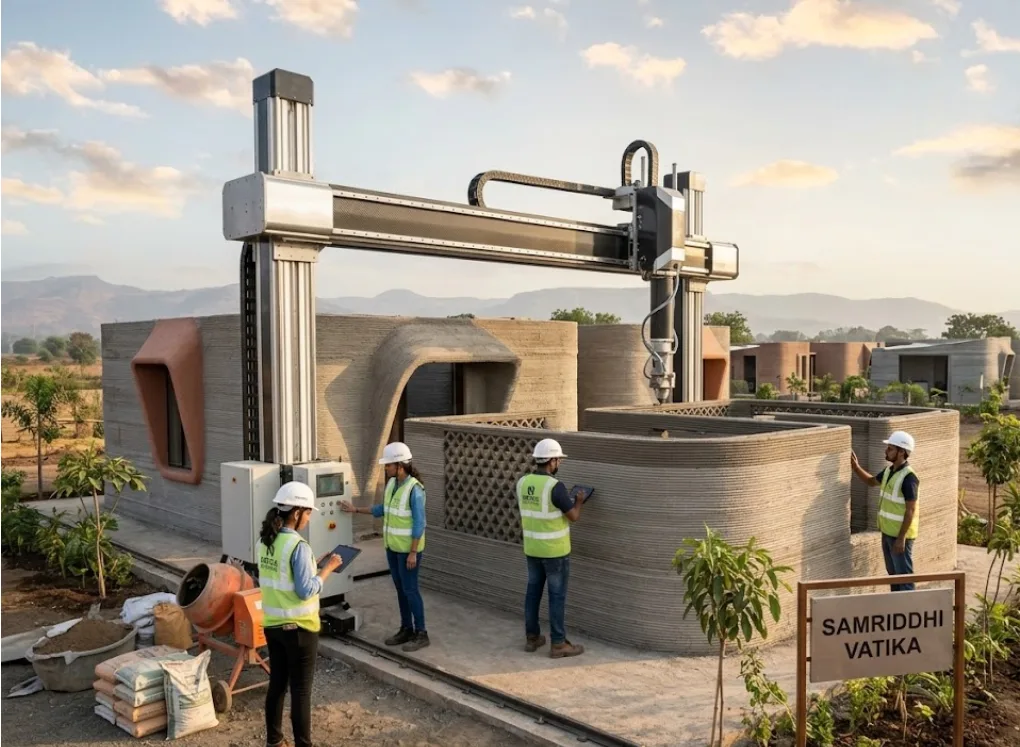
The era of waiting six months for a brick-and-mortar house to stand upright is dying a slow death in February 2026. Though traditional developers still rely on heavy machinery and armies of labor, a new generation of technology is quietly shaping the future of Indian Real Estate. Construction sites are transforming into precision laboratories where giant robotic arms layer concrete with surgical accuracy.
This is no longer some far-off science fiction dream. This is a practical reality that cuts timelines and reduces waste. Investors who ignore this shift will find themselves holding onto obsolete assets very soon.
The end of the six-month deadlines
Construction speed is the most brutal reality of the traditional building process. Most projects get stuck in labor disputes or material shortages, pushing delivery dates by years. 3D printing flips this script by working through the night without a single coffee break. A standard three-bedroom structure that once took half a year can now be finished in 14 days. This speed is the biggest driver for the massive surge in tech adoption seen in early 2026.
- Continuous printing Modern robotic systems run twenty-four hours a day with only three people monitoring the entire site.
- Rapid foundation setting. Quick-dry concrete mixes allow the next layer to be printed within minutes of the previous one.
- Zero labor delays. Automation eliminates the risk of site shutdowns caused by seasonal worker migration or local strikes.
- Instant modification: Digital blueprints allow for on-the-fly design changes without tearing down a single wall manually.
Sustainability without the corporate fluff
Sustainability in 2026 is no longer about just planting a few trees around a concrete parking lot. A real green building means reducing the actual carbon footprint of the materials used in the walls. 3D printing is an additive process, which means the machine only pours exactly what the design requires. There are no piles of broken bricks or leftover cement bags. The earth literally breathes easier when a house is printed rather than poured into wooden frames.
- Material efficiency: Traditional construction wastes thirty percent of materials, while 3D printing reduces that waste to under two percent.
- Eco-friendly mixes. Most 2026 printers use geopolymer concrete, which replaces traditional cement and cuts carbon emissions by half.
- Natural insulation. Machines print hollow lattice patterns inside walls that trap air and keep homes naturally cool in the summer heat.
- Local sourcing. Many systems use local soil and industrial byproducts to produce printing paste on-site.
Breaking the 2026 cost barrier
Money talks louder than technology ever will in the Indian property market. The initial high cost of importing these giant printers was the only thing holding the industry back until last year. Now that local players have entered the market with homegrown machinery, the cost per square foot has plummeted. It is becoming cheaper to print a high-quality home than to build a low-quality one using old methods. Developer profit margins are expanding while end-user prices are finally becoming reasonable.
- Drastic labor savings: Reducing a crew of fifty workers down to five operators slashes the overhead costs of any project.
- Logistics optimization Printing on site means fewer trucks carrying heavy precast blocks or bricks through city traffic.
- Predictable pricing. Digital designs provide a precise estimate of material usage, preventing the usual budget overruns.
- Lower loan interest. Faster completion means developers pay less interest on construction finance, and buyers get possession sooner.
Engineering facts and structural strength
Doubts about whether a printed wall can survive a monsoon or a minor tremor are finally being answered by hard data. February 2026 tests show that graphene-infused concrete layers are actually stronger than traditional hand-plastered walls. These machines do not make human errors, such as leaving air pockets or using an incorrect water-to-cement ratio. The precision of a computer-controlled nozzle ensures uniformity throughout the structure.
- Graphene reinforcement. The filaments used in new Indian projects provide a higher tensile strength than ordinary Grade M30 concrete.
- Seamless structure. Painting the wall as a single unit eliminates the joint gaps, which are always prone to cracks and leakages.
- Precision curing. Automated sensors monitor concrete moisture levels in real time to ensure optimal drying.
- Seismic resistance. The ability to print curved and organic shapes improves weight distribution during earthquakes.
Regulatory shifts in the modern market
The legal framework is the final piece of the puzzle that is falling into place this month. Municipal corporations are moving away from old building codes that only recognized brick and stone. Specialized certificates are now being issued for 3D-printed load-bearing structures across major cities. This regulatory green light is why we are seeing more tech-focused projects popping up on the outskirts of Pune and Navi Mumbai. The path is clear for a total industry takeover.
- New IS codes: Government bodies are finalizing the first dedicated Indian Standard codes for additive manufacturing in construction.
- Fast track approvals Projects using 3D technology often get priority clearance because they meet higher safety and green standards.
- Insurance acceptance: Major insurance firms now cover 3D printed homes at the same rates as traditional buildings.
- Banking support: Home loans are easily available for tech-driven projects, as structural longevity is officially proven.
Designing the new standard of living
The straight lines of traditional formwork no longer limit designers in 2026. If a buyer wants a house with curved walls or an organic shape that mimics nature, the printer can produce it at no extra cost. This freedom is drawing a new generation of homeowners who cherish beauty as much as function. The houses of the future will resemble art more than they do right now.
- Organic geometries Printers can build intricate curves beyond the possibility or cost justification of conventional builders.
- Custom interior features The shelving units and decorative wall pattern may also be printed as part of the structural walls.
- Adaptive architecture Digital files enable the replication of a successful design in various parts of the country.
- Minimalist aesthetics. The raw texture of printed concrete has become a luxury design trend in high-end residential projects.
Frequently asked questions
In 2026, the technology is perfect for villas and three-story buildings, but high rises still require traditional steel frames for now.
The geopolymer mixes are highly waterproof, and the lack of joints prevents the typical seepage issues found in old buildings.
Yes, because the digital file of the house exists, any structural changes can be calculated and executed safely using standard tools.
Modern graphene and cement mixes are designed to last for over fifty years with minimal maintenance required.

Write Your Comment