
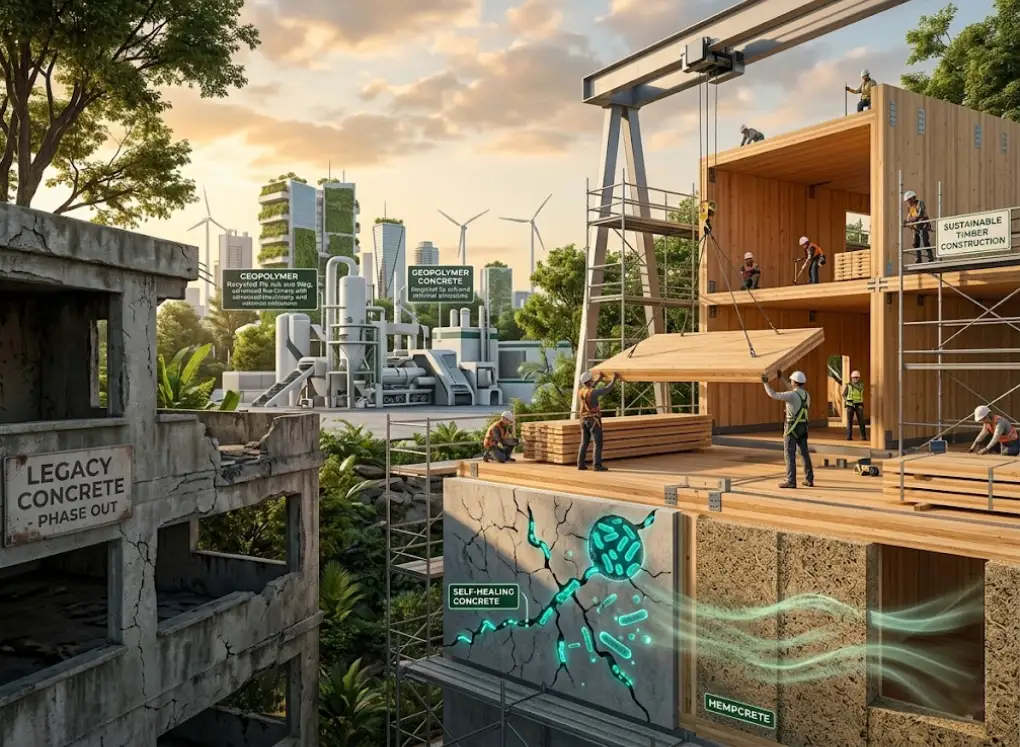
The construction world is finally waking up to the fact that sticking with old-school cement and steel is a losing game for both the planet and your long-term maintenance budget. We are seeing a massive shift in which the lab meets the construction site, and it is not just about being green or saving a few trees. It is about building structures that actually perform better, last longer, and even fix themselves when things go south. If you are still thinking that sustainable building is just about bamboo floors, you are missing out on the actual tech revolution happening right now in the structural core of our cities.
This guide is about the high-tech materials replacing the grey slab, and why the smartest developers are moving toward mass timber and living concrete to stay ahead.
Mass Timber and the Engineering of Wood
Engineered wood panels are no longer just for small cottages, thanks to high-tech layering that has made them as strong as steel but much easier to build with. This tech is allowing us to build high-rise towers that actually store carbon within their walls rather than releasing it during the production of heavy concrete.
- High load capacity: Cross-laminated timber uses layers of wood glued at right angles to create massive slabs that can support the weight of a ten-storey building without breaking a sweat.
- Fire performance secret: Contrary to what people think, mass timber does not just catch fire and collapse; the outer layer chars, creating a natural shield that protects the structural core.
- Rapid site assembly: Since these panels are precision-cut in a factory using computer designs, they arrive on site like a giant Lego set that can be bolted together in half the time of a traditional build.
- Lighter foundations are needed: Because wood is much lighter than stone or concrete, you can build taller structures on softer soil without needing massive, expensive underground reinforcements.
Living Concrete and Self Healing Technology
One of the coolest things happening in material science is the creation of concrete that behaves more like a living skin than a dead block of stone. We are seeing buildings that can detect their own cracks and fix them using biological or chemical triggers before the damage spreads to the internal steel.
- Bacterial spores: Specific types of bacteria are mixed into the wet concrete and remain dormant until a crack appears and water enters, waking them up to produce limestone and seal the gap.
- Capsule-based repair: Tiny microcapsules filled with a sticky healing agent are embedded in the mix, and they break open only when a crack hits them, instantly gluing the structure back together.
- Capsule-based repair: Tiny microcapsules filled with a sticky healing agent are embedded in the mix, and they break open only when a crack hits them, instantly gluing the structure back together.
- Zero-maintenance dreams: While the initial cost is higher, you save a fortune over 30 years because you don’t have to hire teams to do patchwork or waterproofing every 5 years.
Hempcrete and the Power of Bio Composites
Hempcrete is a mix of hemp fibers and lime that creates a walling material that actually breathes and regulates the temperature inside your house without needing a heavy air conditioner. It is a carbon-negative material, which means the plant absorbed more carbon while growing than the building process actually emitted.
- Natural thermal mass: This material holds onto the cool night air and slowly releases it during the hot day, keeping indoor temperature steady without spiking your electricity bill.
- Mold and pest resistance: Because of its high lime content, hempcrete is naturally toxic to termites and fungi, making it perfect for humid climates where damp walls are a constant headache.
- Vapor permeability: Unlike plastic paint or cement plaster, hempcrete allows moisture to move through the wall, so you never get that stuffy, unhealthy air trapped in your living room.
- Acoustic insulation: The porous nature of the hemp fibers makes it an incredible sound barrier, which is great for quiet homes in the middle of a noisy and chaotic city
Geopolymer Concrete and Zero Cement Solutions
The biggest villain in construction is the carbon footprint of cement, but new tech is allowing us to make concrete using industrial waste like fly ash and slag instead. This is called geopolymer concrete, and it is proving to be much tougher and more fire- and acid-resistant than the standard mixture.
- Industrial waste utilization: By using waste from power plants and steel factories, we are cleaning up the environment while building incredibly durable roads and bridges.
- High chemical resistance: This type of concrete does not react to acids or sulfates, making it the go-to choice for sewage pipes and industrial floors that are often eaten away.
- Lower curing water: Traditional cement needs to stay wet for weeks to get strong, but geopolymer tech sets much faster and uses way less of our precious water resources during construction.
- Extreme heat tolerance: These slabs can handle much higher temperatures without cracking or losing their strength, which is becoming vital as our summers get hotter every year.
Common Queries on Modern Materials
Yes, because it has passed every major fire and seismic test, and the latest building codes in most global cities now allow timber towers up to eighteen storeys or more.
It is mostly designed for microcracks and small fissures that lead to leakage, but for major structural breaks, you still need traditional engineering repairs.
Currently, hempcrete is used as an infill or insulation material because it is lightweight, so you still need a frame made of wood or steel to support the roof’s actual weight.
It is mostly used for big infrastructure projects like highways and bridges right now, but precast blocks for residential use are slowly hitting the market.

Write Your Comment