
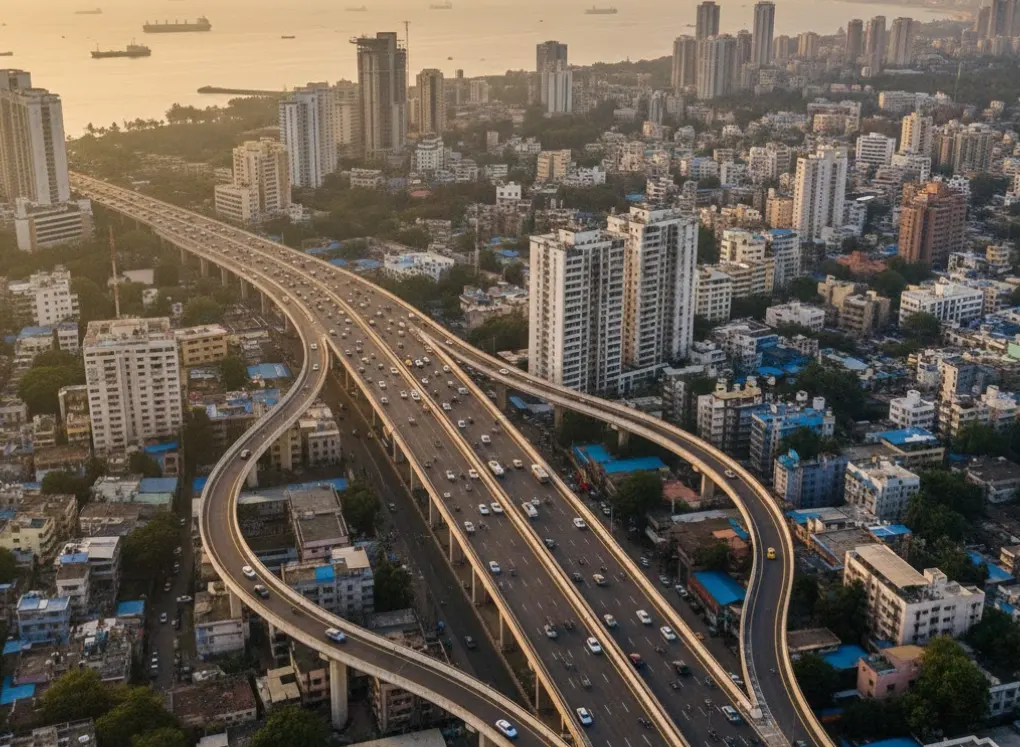
Mumbai teaches patience in ways no other city does. Especially when it comes to commuting. A short distance on the map often turns into a long, exhausting journey on the road. If you have ever tried crossing the city from east to west during office hours, you already know how unpredictable the travel time can be.
Sewri and Worli sit barely a few kilometres apart. Yet for years, travelling between them meant dealing with packed roads, traffic signals and bottlenecks that refused to clear. What should have been a simple thirty-minute drive regularly stretched beyond an hour. The Sewri Worli elevated connector is meant to change that experience. Not gradually. Not partially. But in a way that directly affects how people move across Mumbai market every single day.
This is not just another infrastructure announcement. It is a project that changes daily routines, work location choices and even where people decide to live. If you commute in Mumbai or are planning to buy property here, understanding this connector matters more than you think.
Why East-West travel has always been a problem
Mumbai did not grow evenly. Jobs moved west. Housing spread east. Over time, this imbalance created pressure that existing roads could not handle. Most business districts, such as Lower Parel, Worli and Bandra, developed on the western side. Meanwhile, large residential populations settled in Chembur, Ghatkopar, Vikhroli and beyond.
Every morning, lakhs of people travel from east to west. Every evening, the same journey repeats in reverse. The problem is not distance. It is connectivity. Once commuters exit the Eastern Freeway, they are forced onto surface roads. Traffic signals slow everything down. Pedestrian movement adds unpredictability. One stalled vehicle can block an entire stretch.
The city needed a direct, uninterrupted route. The Sewri Worli elevated connector is that route.
What the Sewri Worli connector actually does
At its simplest, the connector creates a continuous elevated path between Mumbai’s eastern and western transport corridors. It starts near Sewri along the Eastern Express Highway. From there, it runs elevated through central Mumbai and connects directly to the Bandra Worli Sea Link.
Because the entire stretch is elevated, vehicles move without interruptions.
No signals
No crossings
No local traffic interference
This is the real advantage. Not speed alone, but consistency.
How the route is structured
Understanding the route helps explain why this project carries so much importance.
Sewri is the entry point
Sewri acts as the gateway from the eastern side. Traffic from Navi Mumbai, Thane, Chembur and Ghatkopar converges here before entering central Mumbai.
By placing the starting point at Sewri, the connector becomes accessible to a wide eastern population, not just nearby localities.
Parel and Prabhadevi, the bypass
Parel and Prabhadevi have transformed over the last decade. Old industrial zones have given way to offices, residential towers and retail spaces. What did not change was the road width.
Traffic congestion here became routine. The connector avoids all of this by staying above ground level. You move across these areas instead of through them.
Worli the Western link
At the western end, the connector merges with the Bandra Worli Sea Link. From here, commuters can move north toward Bandra or south toward South Mumbai and the Coastal Road.
This connection turns the connector into part of a larger network rather than a standalone road.
How commute times change in real life
This project is not about theoretical benefits. It changes actual travel time. Chembur to Lower Parel currently takes close to an hour during peak hours. With the connector, this drops to roughly twenty to twenty-five minutes. Ghatkopar to Worli often takes more than an hour today. The elevated route brings it down to around thirty minutes.
Navi Mumbai to Bandra is one of the most stressful commutes in the region. Today it can take two hours. With the connector and Sea Link combined, this can be reduced to under an hour. These are not minor improvements. They change how people plan their day.
Why this matters for where people choose to live
Commute time plays a huge role in housing decisions. When travel becomes predictable, people reconsider locations they earlier avoided.
Eastern suburbs gain a clear advantage.
- Faster access to western business districts
• Reduced daily travel stress
• Better work-life balance
This shift does not happen overnight. But once the connector becomes fully operational, demand patterns adjust steadily.
What this means for property markets
Infrastructure has always shaped Mumbai real estate. When connectivity improves, two things happen. People are willing to travel slightly longer distances if the journey is smoother. Areas that were considered inconvenient suddenly become viable. Parel and Prabhadevi benefit from congestion relief. Living close to work becomes more practical.
Lower Parel remains a corporate hub, but the connector allows professionals to live further east without sacrificing time. Worli gains even more appeal because it now connects seamlessly to both sides of the city. Eastern suburbs such as Chembur and Ghatkopar benefit indirectly. They offer comparatively better pricing with improved access to premium work zones.
Property prices do not jump instantly. But improved infrastructure consistently supports long-term appreciation.
The practical challenges to keep in mind
This project is important, but it is not flawless. Completion timelines have shifted before and may shift again. Buyers should factor this in.
Tolls will apply. Daily commuters will need to weigh time savings against cost. The connector works best alongside the Coastal Road and Metro projects. Delays elsewhere can limit its immediate impact.
Maintenance will be critical. Elevated roads require consistent upkeep in Mumbai’s coastal conditions. These are realistic considerations, not deal breakers.
How urban planners view this project
From a planning perspective, the connector does more than reduce traffic.
It redistributes demand. When east-west movement becomes easier, development pressure spreads more evenly across the city. This reduces overdependence on western suburbs and allows eastern areas to grow more sustainably.
Over time, this leads to better balance in housing supply and employment zones.
Should this influence your decisions?
If you are buying property anywhere along this corridor or in the eastern suburbs, the answer is yes. Better connectivity improves daily life. It supports rental demand. It strengthens long term value.
But infrastructure alone should not drive a purchase. Location, fundamentals, pricing and developer reliability still matter most. The connector adds value over time. It does not guarantee instant returns.
The bigger picture for Mumbai
The Sewri Worli elevated connector is part of a wider shift. Metro expansion the Coastal Road and the Trans Harbour Link are all changing how Mumbai functions. Together, these projects reduce friction in daily movement. They expand where people can live without feeling disconnected.
This connector will not solve Mumbai’s traffic overnight. But it moves the city in the right direction. For a city that has lived with gridlock for decades, that progress matters.

Write Your Comment