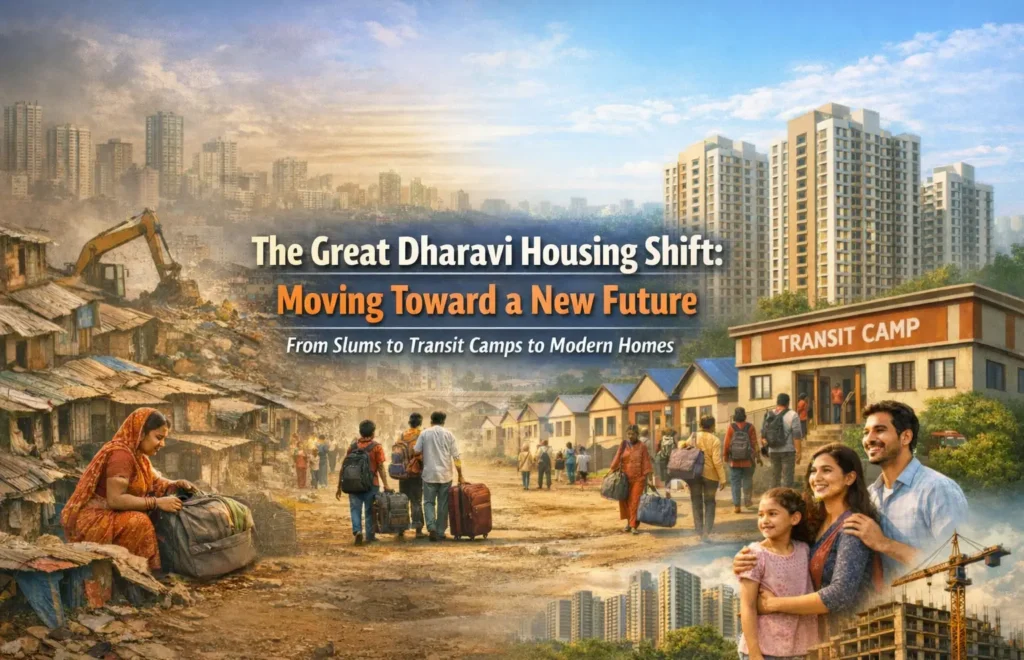
Dharavi, often called one of the largest slum clusters in Asia, is standing on the brink of a massive transformation. For decades, the talk of “redeveloping” this vibrant, busy patch of Mumbai has been a constant headline. Recently, that talk has turned into action, but with a significant twist for the people who live there. Thousands of residents are now being asked to move into temporary “transit homes” or rental accommodations to clear the way for construction.
The end of “key-to-key” dreams? For a long time, the promise made to Dharavi residents was simple: “key-to-key” rehabilitation. This meant that a family would stay in their current home until their new, permanent apartment was ready, moving directly from the old to the new.
However, project officials recently clarified that this isn’t always possible. To build large modern buildings, you need empty ground. To get that ground, some residents must move out first. While this shift has caused some worry, officials argue it is the only way to speed up the work and turn the dream of better housing into a reality.
Relocation and financial support, the relocation process has already begun in specific sectors. For example, in areas like Meghwadi-Ganesh Nagar, residents received notices to move so that essential infrastructure, like sewer lines, could be laid.
To support those moving out, the government is offering financial help. Eligible families are being provided with monthly rent, ranging from ₹15,000 to ₹18,000, allowing them to find temporary housing elsewhere while they wait for their permanent homes. In other cases, residents are being moved to existing buildings in nearby sectors that have been designated as “transit camps.”
The Challenges of change, while the goal is a modern Dharavi with better sanitation and safer buildings, the transition is not without hurdles. Many residents are concerned about how long they will remain in “temporary” housing. There is also the challenge of the “cutoff date.” In Mumbai’s redevelopment rules, only those who can prove they lived in the area before a certain year (usually 2000) are eligible for free permanent homes. Those who moved in later may have to seek housing in different parts of the city, which is a major point of debate.
Looking ahead, the Dharavi redevelopment is not just about moving bricks and mortar; it is about moving lives. The project aims to provide residents with self-contained flats that have proper toilets, clean water and better electricity. For the thousands currently packing their bags for transit homes, the hope is that this “temporary” shift is a short bridge to a much more stable and comfortable future.
As the construction begins to rise, the eyes of the world, and the rest of Mumbai, will be watching to see if this massive experiment in urban living succeeds.
Also Read – MTNL approves prime BKC property sale to NABARD for ₹350 crore
Disclaimer – This article provides a general overview of current events. Readers should verify specific eligibility rules and government policies with official authorities as project details may change over time.
Source – ET Realty

Write Your Comment