
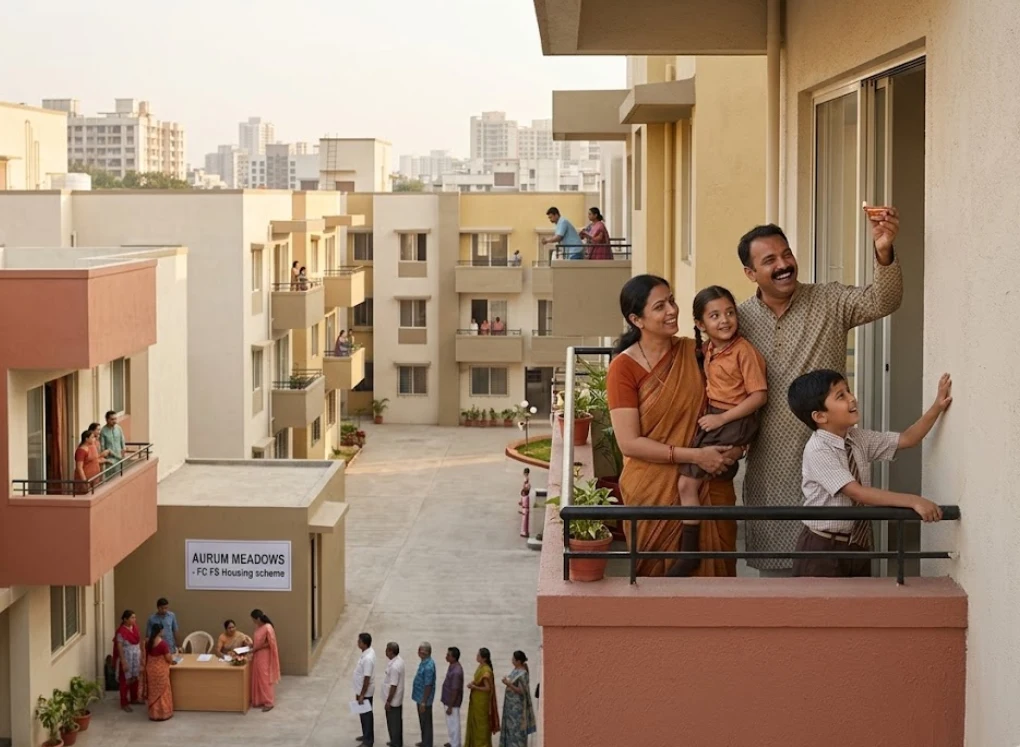
The Maharashtra Housing and Area Development Authority (MHADA) recently sold a home in Mumbai, and there was an interesting trend in the housing market. In a special “First-Come-First-Served” (FCFS) program, more than half of the houses that were available were sold very quickly. But if you look more closely at the data, you’ll see a big difference between what Mumbaikars want and what they can realistically pay.
Quick Success for Mid-Range Homes
Out of the 118 residences listed for sale in this round, 64 sold practically immediately. These homes, situated throughout the city, were intended at middle-income families trying to establish themselves in Mumbai’s competitive real estate market. The “First-Come-First-Served” technique differs from MHADA’s traditional lottery system in that it allows anyone to book a flat immediately by paying a token amount online, similar to reserving a movie ticket or a hotel stay.
The speed with which these 64 properties were claimed indicates that the demand for “government-approved” housing remains strong. Buyers trust these projects because they have strong legal titles and are typically less expensive than those built by private builders in the same community.
The Luxury Logjam
The low- and middle-range apartments got a lot of interest, but the high-end apartments didn’t get nearly as much. A lot of expensive houses, some priced at an unbelievable ₹4.8 crore, were still not sold. These high-end apartments are in great places, like Tardeo in South Mumbai.
The fact that these high-priced apartments are still empty shows that MHADA has a lot of competition in the high-end market from the private sector. People willing to spend around ₹5 crore usually want high-end features for their lifestyle, like infinity pools, designer lobby areas, and top-notch the services of a These may not always be a priority for government-built buildings.
Location and Pricing: The Deciding Factors
Many of the homes that sold quickly were in the “sweet spot”: they were in well-connected areas and didn’t cost too much for a working-class family to afford. On the other hand, the units that haven’t been sold show that the government’s pricing plan doesn’t match up with what buyers want in high-end housing.
A lot of people think of MHADA as a place to get “affordable” housing. It’s hard for the “brand” when the price goes up to several crores. There’s no reason to pay ₹4.8 crore for a government flat when a private developer could offer a project with more “glamour” for the same amount of money.
A Lesson for Future Schemes
Planners of cities can learn a lot from this sale. Proof that people in Mumbai want to live somewhere, not just any place to sleep, and that they want to live somewhere that is affordable. The 64 sales show that the FCFS method works well for lower-priced items, and it cuts down on the long wait times that come with traditional lotteries.
As Mumbai continues to grow, the main goal will probably still be to make more houses that are affordable for most people. Even though high-end apartments may eventually sell, the real win for the city is the 64 families who were finally able to find a place to live in one of the most expensive towns in the world.
Disclaimer: This article is for informational purposes only and is not official government advice. Property availability and prices are subject to change. Please verify all details on the official MHADA portal.
Also Read: Buyer Rights vs. Builder Rules: A Lesson from Telangana’s Recent Property Ruling
Source: Hindustan Times

Write Your Comment