
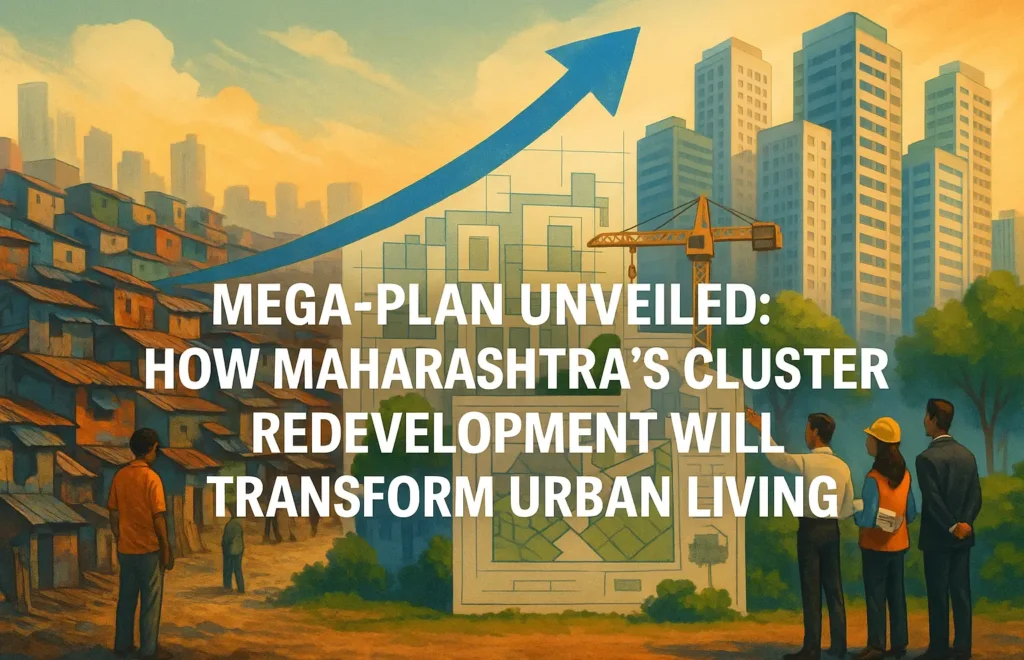
For decades, transforming the dense, sprawling informal settlements in cities like Mumbai has been a slow and challenging process. Previous efforts, often focusing on small, fragmented land parcels, frequently stalled due to complex land ownership, legal challenges and the difficulty of obtaining permission from every single resident, to overcome these massive hurdles and realize the dream of a ‘Slum-Free City,’ the Maharashtra government has rolled out a landmark policy, the Slum Cluster Redevelopment Scheme (SCRS).
This new policy signals a complete shift in strategy, moving away from fragmented, building-by-building fixes to a large-scale, comprehensive urban overhaul. The core idea is to treat large swathes of land as a single development unit, enabling better planning and infrastructure.
The Move to mega-scale
One of the most defining aspects of the new policy is the sheer scale required. The scheme targets “clusters,” which must cover a minimum continuous land area of 50 acres. Critically, at least 51% of this area must be occupied by slums. This huge scale ensures that redevelopment isn’t just about putting up a new building; it’s about creating entirely new neighborhoods with planned roads, utilities, water supply and open spaces.
Moreover, the land included in a cluster is no longer limited to just one type of ownership. It can combine private property, state government land, municipal plots, and even central government land (with necessary permissions). This flexibility is vital in Mumbai, where slum areas often cross multiple boundaries, preventing unified development until now. The scheme also encompasses other non-slum structures within the boundaries, including old and dilapidated buildings, cessed properties, and tenanted units, thereby bringing the entire area under a single, cohesive master plan.
Removing the roadblock of consent
The most dramatic change in the new rule is the decision to remove the requirement for individual slum-dwellers consent in cluster projects. Under the old system, projects could be indefinitely delayed if a single resident refused to sign an agreement, essentially giving veto power to individuals.
The new policy eliminates this, asserting that large-scale redevelopment of this nature is a matter of public interest. This move is expected to drastically speed up the pace of work, helping the government meet its goal of building around 500,000 new homes for slum-dwellers by 2030.
Implementation and benefits
The entire program is managed by the Slum Rehabilitation Authority (SRA), which acts as the main body. Once a cluster is identified, a High-Powered Committee reviews and grants approval, ensuring senior oversight for these massive projects.
For developers, the incentive lies in the project size and special permissions, like a higher-than-usual Floor Space Index (FSI), which allows them to build more on the sale component of the land. This revenue from sale of apartments pays for the free homes provided to the eligible slum residents, making it a financially viable model without needing direct government investment.
Private landowners within the clusters are also protected. They are offered fair compensation or developed plots in return for their land. If they refuse, the government has the right to acquire the land to ensure the project benefits the wider community, but the developer bears the cost of this acquisition.
By focusing on a consolidated, large-scale approach, the Cluster Redevelopment scheme promises a significant overhaul of the urban landscape, creating not just safe, permanent homes for the needy but also fostering well-planned, integrated and modern parts of the city.
Also Read – The end of veto power: How Maharashtra is transforming slum redevelopment
Disclaimer – This article summarizes a government policy based on public reports. Consult official government resolutions for the complete and legally binding information on the Slum Cluster Redevelopment Scheme.
Source – Hindustan Times

Write Your Comment