
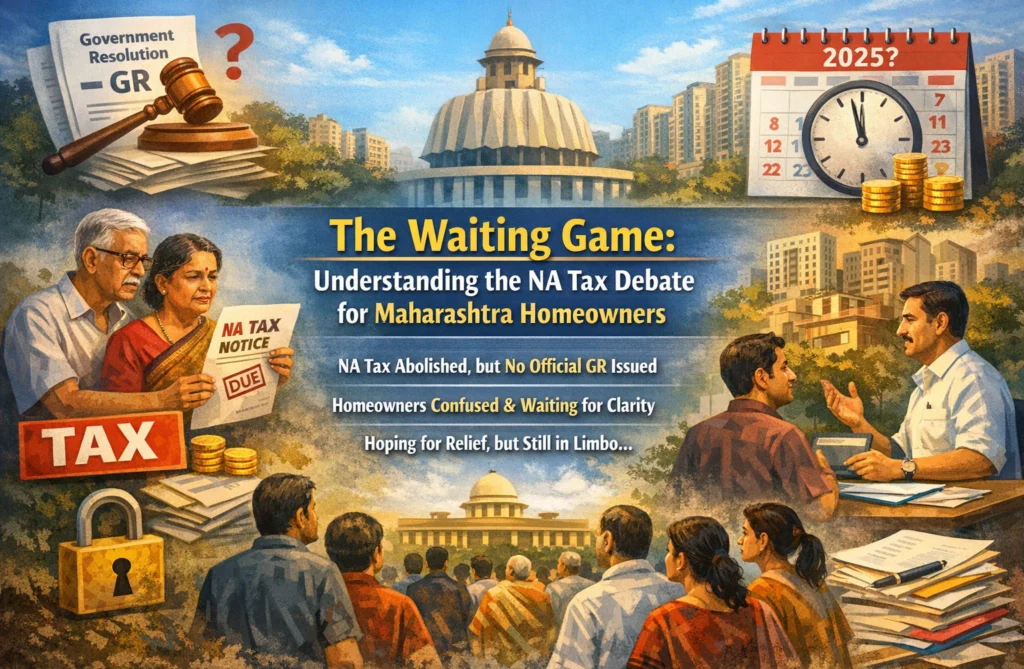
For decades, thousands of housing societies across Maharashtra have been paying a specific fee known as the Non-Agricultural Tax, or NA Tax. Recently, news of this tax being cancelled has sparked hope among homeowners. However, while the announcement brought a wave of relief, the actual implementation has left many residents and committee members in a state of confusion.
What is the NA tax?
To understand the current situation, we must first look at what this tax is. Historically, much of the land in Maharashtra was reserved for farming. When a builder wants to construct a residential building on such land, the usage of the land must be changed from agricultural to non-agricultural.
The government charges an annual fee for this conversion. Even though residents pay property tax to their local municipal corporation, they are often asked to pay this additional NA Tax to the state revenue department. Many homeowners feel this is a double burden, as they are already paying for civic amenities through their regular property tax.
The Big announcement and the current delay
In late 2024, the state cabinet took a landmark decision to abolish this tax for residential properties in urban areas. This was seen as a major win for the middle class. The goal was to reduce the financial load on cooperative housing societies and simplify the rules for land use.
However, a year has passed, and many societies are still receiving tax notices. The reason is simple: the government has not yet released the official document known as the Government Resolution, or GR. In the world of administration, a verbal promise or a cabinet decision is not enough to stop the collection of money. Local officers need the written GR to officially update their records and stop sending payment demands.
Why the confusion matters
This delay has created a split among housing societies. Some societies have stopped paying, believing the tax is gone forever. Others continue to pay because they fear the heavy penalties. If a society stops paying and the law isn’t officially changed, they might face an interest charge of nearly two per cent per month.
On the other hand, the Maharashtra State Housing Federation is actively pushing the government to finish the paperwork. They argue that as long as there is no clear written order, local authorities will continue to pressure residents for money, leading to unnecessary stress and legal battles.
What should residents do?
Until the official order is signed and shared, the legal status of the NA Tax remains in a grey area. Homeowners are advised to stay updated through their society federations and check for any new notifications from the revenue department.
The abolition of this tax would mean more savings for every household and less paperwork for society managers. It represents a shift toward making urban living more affordable and reducing the layers of old, complex rules. For now, millions of residents across cities like Pune, Mumbai, and Nagpur are keeping a close watch on the state cabinet, waiting for that one final piece of paper that will turn a promise into a reality.
Also read – Hidden risks in the city: How to stay safe from Mumbai real estate fraud cases
Disclaimer: This article is for informational purposes only and does not constitute legal advice. Please consult with official government resolutions or a legal expert before making financial decisions for your society.
Source – ET Realty

Write Your Comment