
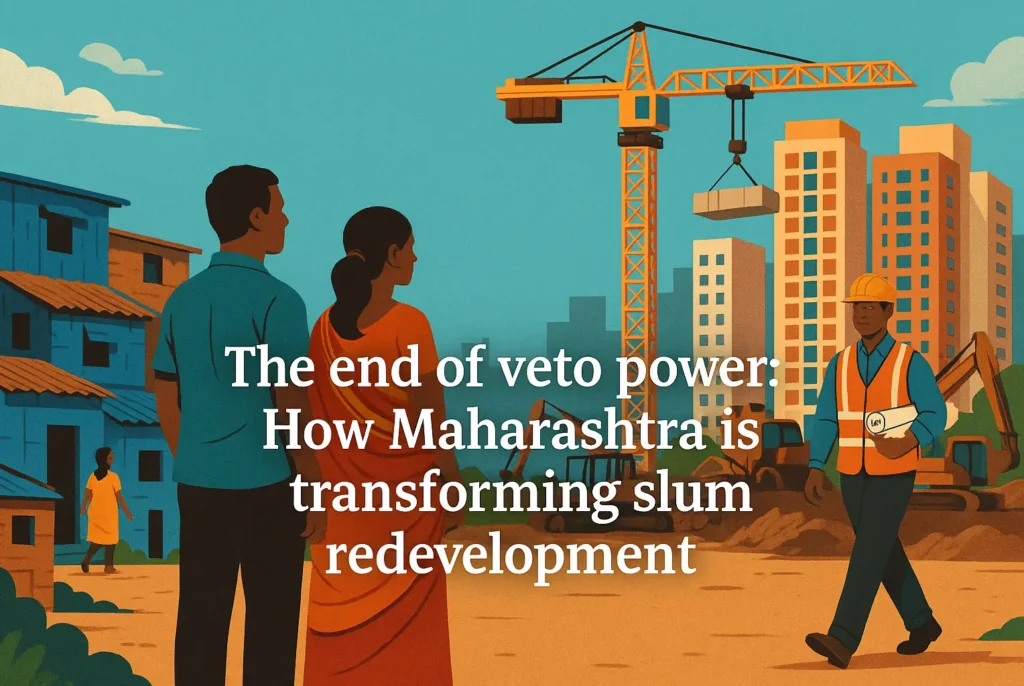
For decades, the path to redeveloping Mumbai’s sprawling slum areas has been slow, often bogged down by legal battles and the challenge of securing approval from every single resident. Now, the Maharashtra government has introduced a bold new order aimed at cutting through the red tape and fast-tracking the mission to make the city slum-free.
The core of this significant change, issued recently by the state, centers on cluster redevelopment, a strategy focused on transforming large sections of slum areas rather than just individual pockets.
No more individual consent
The most striking feature of the new policy is the removal of the requirement for individual slum-dwellers’ consent in group redevelopment projects. Previously, a single dissenting voice could stall a project, sometimes for years. By shifting the focus from individual sign-offs to a broader, cluster-based approach, the government aims to give projects the necessary momentum to proceed swiftly. This change is expected to significantly accelerate the pace of development across the city’s vast slum landscape.
Defining the new scale
This cluster scheme is designed for large-scale transformation. The new rule specifies that the project must cover a minimum continuous land area of 50 acres, with more than 51% of that land designated as a slum area. This ensures that the redevelopment is comprehensive, creating entirely new neighborhoods with improved infrastructure, rather than isolated new buildings.
In a move that could unlock crucial space, the new order also allows for the inclusion of land owned by the central government, a first for a state-level scheme of this nature. This is permitted upon securing the required permissions from the concerned central authorities, potentially adding valuable real estate to the mix.
Inclusion of diverse areas
The scope of this redevelopment is broad. It is not limited strictly to slums. Non-slum structures—including commercial, industrial, or warehousing buildings—located within the designated cluster zone can also be incorporated into the scheme.
Furthermore, areas falling under Coastal Regulation Zone (CRZ) rules, which previously posed significant planning hurdles, can now be integrated. The policy allows for “in-situ” (on-site) rehabilitation or alternative relocation within a 5-kilometer radius for residents of slums in CRZ areas, all in accordance with existing environmental and planning norms.
Who will implement the change?
The Slum Rehabilitation Authority (SRA) has been officially appointed as the central agency responsible for overseeing and implementing these new cluster redevelopment projects.
The development itself can be carried out either through a joint venture involving a government body or by appointing a private developer through a clear and fair bidding process. However, to recognize prior investment, any developer who already holds development rights for 40% or more of the total cluster area may be given priority to execute the project, subject to approval from the high-power state committee.
For any existing SRA projects within the cluster area, the new rule ensures that developers must deposit rental compensation with the SRA for any slum-dwellers who are displaced during the phased construction. This ensures that while the process moves faster, residents are not left without interim support.
Ultimately, this new directive marks a pivotal moment, shifting the focus from incremental building to wholesale Slum Redevelopment and promising a significant overhaul of Mumbai’s housing and urban landscape.
Also Read – Thane, Navi-Mumbai and Bhayandar to lead India’s first pod-taxi revolution
Disclaimer – This article is for informational purposes only, based on current public reports, and does not constitute legal or professional advice. Always consult official government documents for accuracy.

Write Your Comment