
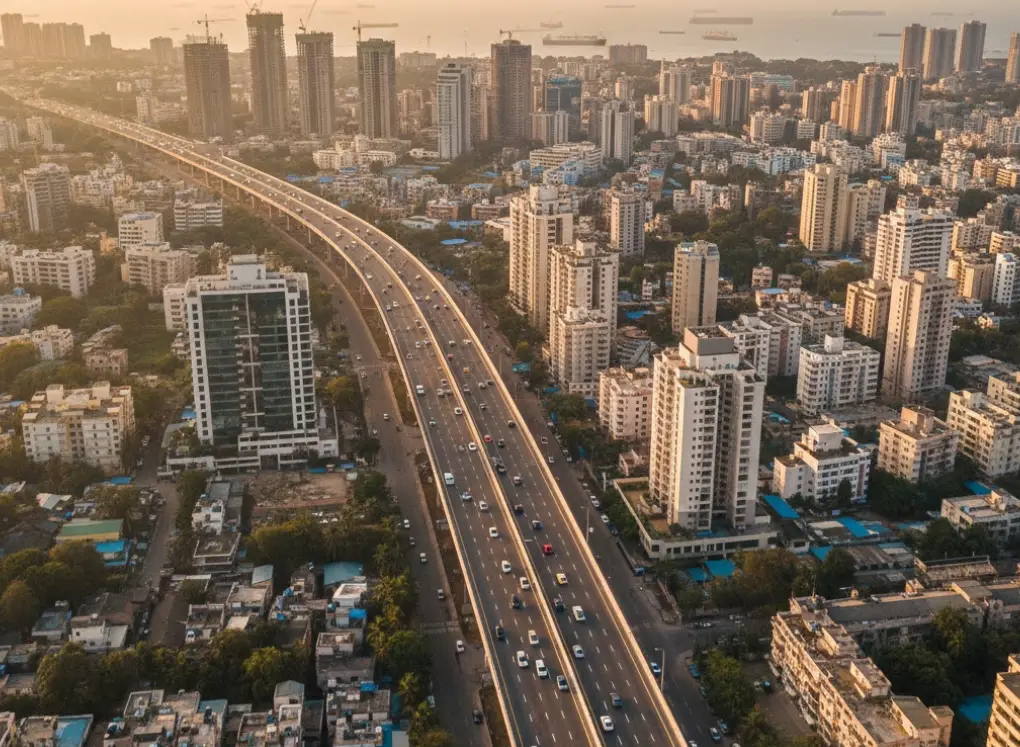
Every city has roads that people stop believing in.
They appear in plans, get discussed in meetings, and show up in news updates. But for the people who travel every day, they feel distant. The Airoli to Katai Naka connection lived in that space for a long time. Necessary, logical, yet always out of reach.
That belief is finally changing.
This freeway matters not because it is new, but because it responds to a long-standing daily struggle. The struggle of indirect travel. The struggle of wasting time between locations that should have been connected years ago.
This is not just an infrastructure update. It is a correction.
Why this corridor always felt incomplete
Mumbai’s expansion did not happen evenly. Navi Mumbai was planned with intent. Kalyan Dombivli grew with population pressure. Airoli became the hinge between opportunity and overload.
What never evolved at the same pace was east to west movement.
People travelling between these regions were pushed onto internal roads. Roads meant for local use slowly absorbed office traffic, heavy vehicles and intercity movement. Over time, everyday travel became unpredictable.
The real issue was not congestion alone. It was the absence of a dedicated route designed for volume.
What daily commuters have been dealing with
Anyone who uses this belt regularly knows the pattern. You leave early to stay safe. You still get stuck. One stalled vehicle or overloaded junction brings everything to a crawl.
The higher cost is not time.
It is uncertain.
- Meetings become harder to plan
Short linear reality that professionals live with daily. - Job opportunities feel limited by travel stress
This quietly shapes career decisions over the years. - Housing choices shrink to what feels manageable
Families compromise not on preference, but on commute fear.
This is the invisible tax people have been paying.
What the freeway is designed to change
The Airoli to Katai Naka freeway introduces a direct, high-capacity corridor between Navi Mumbai and the Kalyan Dombivli belt. Instead of traffic spilling into residential roads, movement is channelled into a route built to handle it.
The intent is practical, not cosmetic.
- Reduce pressure on internal roads
This protects residential neighbourhoods from through traffic. - Create predictable travel windows
Reliability matters more than raw speed. - Support growing housing and commercial zones
Growth becomes sustainable when access is planned.
This road is not about faster driving. It is about calmer planning.
Construction phase frustration and why it was inevitable
The construction phase has not been easy. Diversions, narrowed stretches and temporary congestion tested patience. Locals voiced concerns. Daily commuters felt the strain.
That frustration is understandable.
But it also highlights how essential this link already is. When a road under construction disrupts life this much, it shows how much demand exists for a proper alternative.
As sections near completion, the difference is visible. Wider carriageways. Clear alignment. A sense that the chaos is temporary, not permanent.
How this freeway quietly reshapes property decisions
Infrastructure rarely changes real estate overnight. Its impact is gradual and behavioural.
When connectivity improves, people reassess areas they once avoided. Locations that felt inconvenient start feeling workable. Commutes that felt exhausting begin to feel predictable.
This corridor strengthens the relationship between Navi Mumbai and Kalyan Dombivli.
- Families gain access without sacrificing routine
Schools, healthcare and work become easier to balance. - Professionals regain flexibility
Job choices are no longer dictated by travel anxiety. - Investors see stability driven by usability
Not speculation, but daily relevance.
This is how real demand forms.
Gaps buyers and residents are already thinking about
Optimism exists, but so does caution.
- How smoothly will entry and exit points function during peak hours
Congestion at connection points can undo broader benefits. - Will feeder roads be upgraded alongside the freeway
Last-mile access decides daily experience. - How traffic discipline will be managed initially
Early months shape long-term usage patterns.
These questions are not resisted.
They are expectations shaped by past learning.
Know more about land pooling and development opportunities
Why this project fits Mumbai’s long-term direction
Mumbai is no longer growing inward. It is expanding outward and sideways. Multiple zones now function together rather than feeding into a single core.
For this network to work, connectors matter more than landmarks.
The Airoli to Katai Naka freeway strengthens east-west mobility. It reduces dependency on older corridors and allows growth to distribute without choking one route.
This is how large urban regions mature.
Not through isolated projects.
But through links that hold everything together.
What this road truly represents
At its core, this freeway represents acknowledgment.
Acknowledgment that time has value.
Acknowledgment that stress should not be normalised.
Acknowledgment that planning must respond to lived reality.
For years, commuters adjusted their lives around traffic. This project signals the system adjusting back.
Its success will not be measured by announcements. It will be felt in quieter mornings, predictable evenings and choices that no longer feel restricted by distance.
That is the real infrastructure upgrade.
Not concrete.
Not width.
But control over daily life.

Write Your Comment