
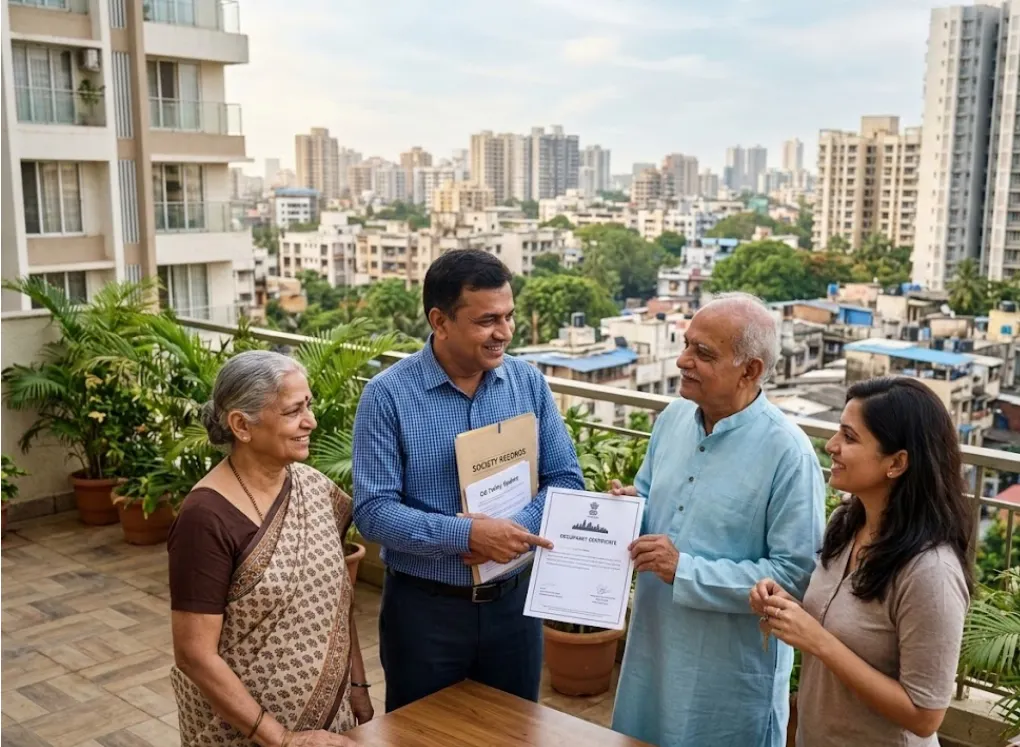
Thousands of Mumbai families have been living in legal limbo for decades. They pay their taxes, own their homes, and attend meetings, but one essential document is missing from their buildings: the Occupation Certificate (OC). A structure isn’t legally “complete” without this paperwork, which raises water costs and makes it harder to get house loans or plan future renovations.
The Brihanmumbai Municipal Corporation (BMC) is planning to implement a comprehensive policy by the end of March 2026, which is a significant advancement. Almost 25,000 housing societies throughout the city will have a “one-time window” to ultimately obtain their legal status thanks to this program.
What is an Occupation Certificate and Why Does It Matter?
Consider an OC as the city’s final stamp of approval. It confirms that the building was constructed according to the approved plans and is safe for people to live in. Even though many of Mumbai’s historic buildings have been maintained for many years, many do not have an OC because of small construction flaws, unmet original constructor obligations, or administrative hold-ups.
The lack of an OC is more than simply a paperwork problem for locals. It frequently entails paying “double” for water connection fees and facing difficulties while trying to sell their apartment or renovate their home.
The New Policy Highlights
The goal of the future Mumbai housing OC policy is to address issues. City officials predict that the framework will have the following characteristics:
- Amnesty Period: The BMC intends to give societies a year to come forward. Instead of enforcing severe penalties during this time, the objective is to promote applications.
- Inclusion of Commercial Units: At first, there was disagreement over whether the benefits should be limited to residential buildings. It will be a complete solution for all property owners, though, as current conversations indicate that commercial units will also be included.
- Simplified Regularization: If some deviations fulfill safety requirements, the policy will permit societies to “regularize” or validate them for a certain charge.
- Fixed Deadlines: The program will probably work under a strict schedule, encouraging societies to respond swiftly to prevent the process from dragging on.
A Step Toward Redevelopment
Mumbai’s weakening infrastructure makes this action especially crucial. Many structures from the 1970s and 1980s are now suitable for renovation. However, without an OC, the legal path to tearing down and rebuilding is filled with obstacles. The BMC is essentially opening the door for thousands of households to move into safer, more contemporary homes in the future by clearing these pending certificates.
What Should Societies Do?
Once the policy is formally announced (most likely by the end of the month), housing society committees should gather their original development blueprints and share them with legal or technical specialists. Because the policy seeks to be user-friendly, it provides the best opportunity in a generation to address long-standing documentation concerns.
Disclaimer: This article is for informational purposes only. Readers should refer to official BMC notifications and consult legal experts before making decisions regarding their property or housing society matters.
Also Read: Maharashtra Budget 2026-27: Tough Penalties for Low Stamp Duty
Source: Hindustan Times

Write Your Comment