
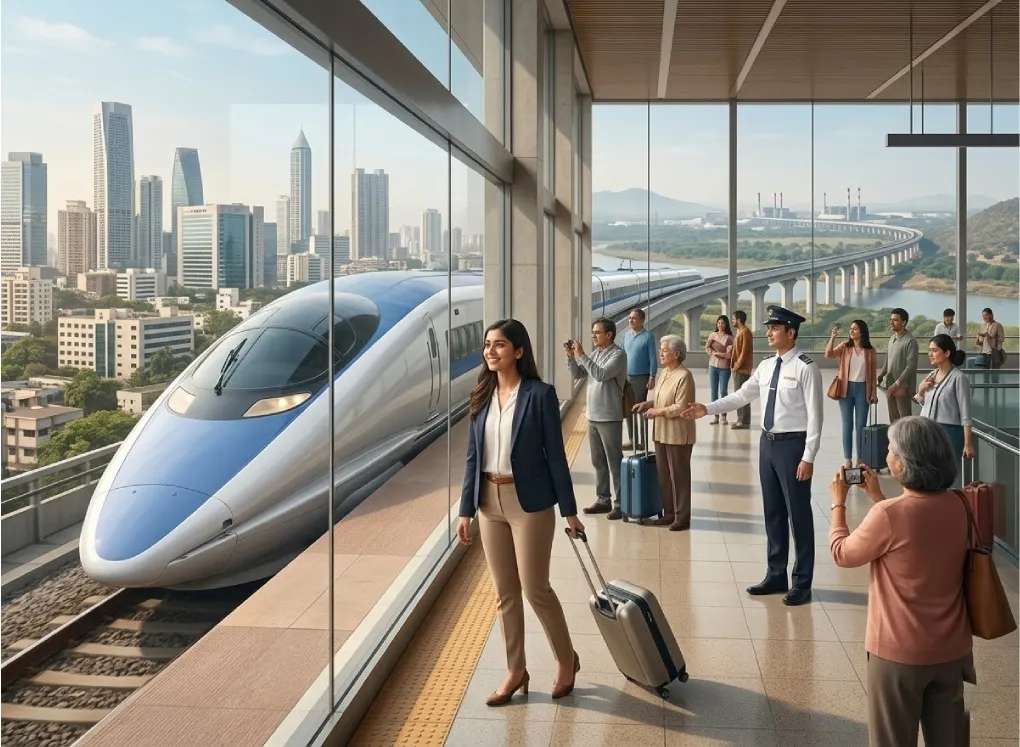
Remember when the idea of a bullet train in India felt like a distant dream we only saw in viral videos from Japan or Europe? As we look at the massive roar of construction stretching across Maharashtra and Gujarat it is clear that the dream has finally hit the ground as a giant engineering feat. We are no longer debating whether it will happen because the silver streak is already taking shape across our skyline at a breakneck pace.
This project is not just about getting from point A to point B faster than a flight but about completely erasing the distance between two major economic hubs. It is changing how we look at our geography and making the hundreds of kilometers between Mumbai and Ahmedabad feel like a short hop on a local metro.
The progress report: Breaking through mountains and creeks
The most recent milestones come from the rugged terrain of Palghar where engineers have managed a double victory with two major mountain tunnel breakthroughs in a single month. Using a specialized technique called the New Austrian Tunnelling Method they have successfully carved through the difficult Western Ghats proving that the toughest geological hurdles are now mostly behind us.
- Mountain tunnel victories: Out of the seven mountain tunnels planned for the Maharashtra section two are now fully open with the rest of the underground work moving toward a mid-year finish.
- Viaduct and bridge status: Over three hundred thirty kilometers of the elevated track is already standing like a giant spine across the landscape with seventeen major river bridges fully completed.
- The BKC terminal: Work at the Bandra Kurla Complex underground station has reached the critical slab casting stage while stations in Gujarat like Surat are already getting their final architectural touches.
- Undersea progress: The massive twenty one kilometer underground stretch includes a specialized section beneath the Thane Creek marking the first time India has built a rail tunnel under the sea.
Two hours instead of seven: The coming travel revolution
Right now a trip from Mumbai to Ahmedabad on the fastest express trains takes about seven hours and driving usually takes even longer thanks to the bottlenecks at the Vasai creek or Fountain Hotel junction. The bullet train is designed to slash that time to just under two hours for the limited stop service which completely changes the game for business and daily commuters.
- Three times faster: The trains will operate at a top speed of three hundred twenty kilometers per hour making it significantly faster than any existing long distance train in the country.
- Metro like frequency: Plans are in place to run a train every twenty minutes during peak hours which means you can just show up at the station without overthinking your schedule.
- Shinkansen safety standards: The system uses the legendary Japanese technology known for having a record of zero passenger fatalities over more than five decades of operation.
- Business mobility: A professional can finish a morning meeting in BKC and be back in Ahmedabad for an early dinner without the stress of airport security or traffic jams.
The real estate boom along the high speed line
Infrastructure projects are the biggest drivers of property value and the bullet train is acting as a massive magnet for investors looking at the next decade of growth. Locations that were once considered far off suburbs are now being rebranded as strategic transit hubs where prices are already beginning to climb as the launch date gets closer.
- Thane as a global hub: With the station being integrated into the local metro and bus networks Thane is evolving into a smart city center that rivals the main island city in terms of connectivity.
- The Boisar and Virar shift: Affordable areas in the Palghar district are seeing a huge surge in demand because they will be connected to the Mumbai business district in less than twenty minutes.
- Industrial growth in Vapi: Small and medium businesses in Gujarat are already eyeing new IT and industrial parks near the stations to tap into the Mumbai talent pool without the Mumbai rent.
- Rental yield potential: Property experts are predicting a significant jump in rental demand as the phased opening approaches making these station adjacent flats a goldmine for investors.
What happens next: The road to the first run
The Ministry of Railways has confirmed a phased approach to opening the corridor to ensure the highest safety standards are met before the full stretch becomes public. The first section in Gujarat is being treated as a live test bed where the initial commercial runs will allow engineers to fine tune the system before it reaches the Mumbai metropolitan region.
- First section launch: The initial fifty kilometer stretch between Surat and Bilimora is scheduled to see its first official public run by the middle of next year.
- Maharashtra connection: High speed operations are expected to extend toward the Thane station shortly after the Gujarat sector is fully operational.
- Full corridor completion: The entire five hundred eight kilometer stretch from Sabarmati to BKC is targeted for a complete finish by the end of the decade.
- Technical training: Thousands of local engineers are currently being trained in Japan to handle the maintenance of the high speed tracks and the specialized rolling stock.
Frequently asked questions
The pricing is expected to be competitive with current flight rates but much more convenient since you save several hours on airport transfers and security checks.
No, because the high speed rail is a separate system with its own ticketing structure and dedicated stations that are not part of the standard suburban railway network.
Yes, the system includes advanced sensors that can detect seismic activity or heavy winds and automatically trigger the braking system to bring the train to a safe halt.
While the exact rules are still being finalized there will likely be dedicated space for luggage though it will be more generous than airline cabins to accommodate regular travelers.

Write Your Comment