
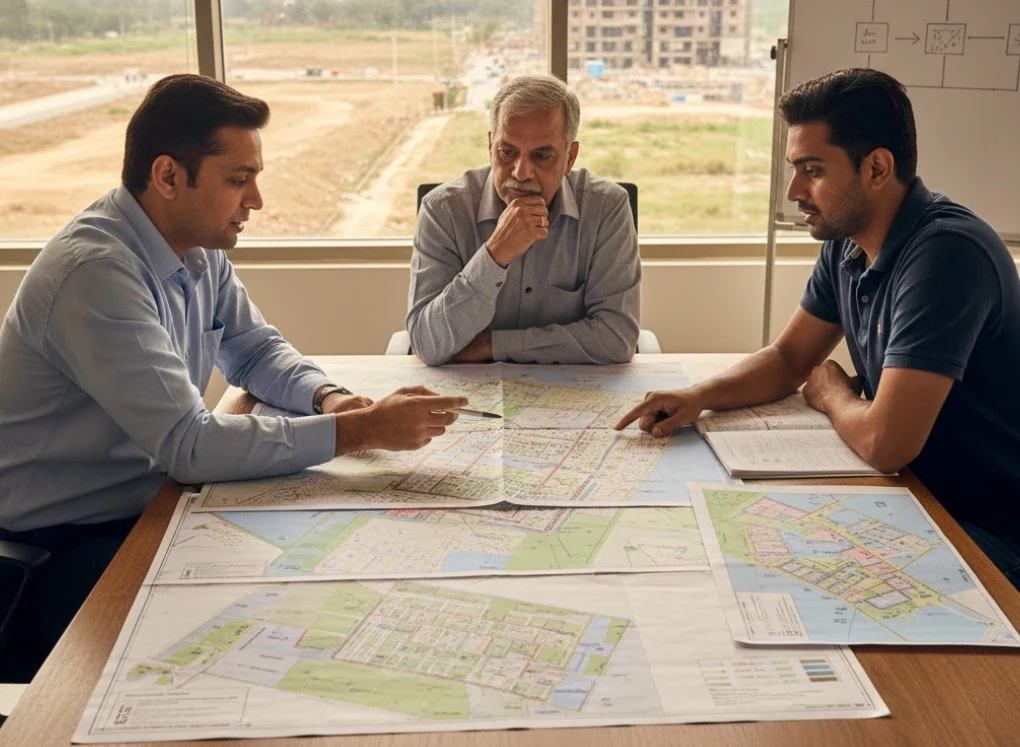
Most people buying a home in India do not start by reading policies. They start with a feeling. A location that seems promising. A price that looks reasonable. A broker says this area will grow fast.
Somewhere in those conversations, a new term often slips in. Land pooling.
For many buyers, it sounds technical and distant. Something meant for planners, not families looking for a home. Some ignore it completely. Others assume it means cheaper land or faster development without really understanding what they are signing up for.
That gap between hearing the term and understanding its impact is where confusion begins. And confusion in real estate always costs money or peace of mind or both.
This guide is written for buyers who want clarity without noise. Not to scare you. Not to sell you anything. Just to help you understand what land pooling actually means for your home and your future.
Why land pooling entered the picture in the first place
Indian cities did not grow in a straight line. They expanded in patches. A road here. A building there. Over time, this created neighbourhoods that worked only until they did not.
Narrow internal roads. No space for utilities. Drainage problems. Areas where development happened faster than planning.
Governments realised that acquiring land forcefully only led to resistance, court cases and stalled growth. That model was breaking down.
Land pooling came in as a different approach. Instead of taking land away, it asked landowners to become participants in development. The idea was simple. If landowners pool their land, the government can plan infrastructure properly. Roads can be wider. Services can be laid out in advance. Open spaces can actually exist.
For buyers, this matters because it changes how neighbourhoods take shape. Not overnight. But over time, in a more organised way.
What land pooling actually means in real life
Strip away the policy language and land pooling is easier to understand.
Multiple landowners in a defined area agree to bring their land together for planned development. The authority develops roads, utilities and public spaces. After that, landowners receive a portion of the developed land back.
They give up some area, but what they get back usually has better access and higher value than before.
Think of it like this. A scattered group of plots with poor access is hard to live in and harder to develop. A planned zone with proper roads and services attracts homes, schools and businesses.
Buyers are not purchasing the policy. They are purchasing the outcome of that planning.
Why buyers often feel uncomfortable around land pooling areas
Even though the idea sounds sensible, buyers often hesitate when land pooling is mentioned. And that hesitation is valid.
The first issue is information. Most buyers are told that land pooling exists, but not how it affects timelines. They do not know when the roads will be ready. When will it reach? Or how long the area will feel unfinished.
The second issue is trust. Buyers have seen too many promises around future infrastructure that took years longer than expected. So when someone says planned development, buyers quietly ask when.
The third issue is daily life. Living in a developing zone can be uncomfortable in the early years. Dust. Temporary roads. Incomplete services. These things do not show up in brochures, but they affect real people.
None of these concerns is wrong. They simply need to be understood before committing.
Where land pooling is shaping growth today
Across India, land pooling has been used more actively in expansion corridors rather than core city areas.
In Maharashtra, parts of the Mumbai Metropolitan Region have adopted land pooling to manage outward growth. Gujarat has applied similar models around Ahmedabad. Telangana has used it in planned city extensions.
These areas often sit near highways, upcoming metro lines, or new employment hubs. That is not accidental. Planned land works best when connectivity is already part of the vision.
For buyers, this signals future importance, not immediate comfort.
How land pooling can work in a buyer’s favour
When land pooling is executed well, buyers benefit in ways that are not always obvious on day one.
Infrastructure tends to be better thought out. Roads are wider. Utility corridors exist. Public spaces are not squeezed in later.
Growth also becomes more predictable. Instead of guessing which direction the city will move, buyers can see where planning attention is focused.
Over time, this predictability supports value stability. Not explosive jumps. But steady confidence that the area will mature rather than stagnate.
This is why long-term buyers often look at land pooling zones differently from short-term speculators.
What you should check before buying in a land pooling zone
Not every project in a land pooling area is equal. Buyers need to slow down and ask grounded questions.
Is the land pooling plan approved or still proposed
Has infrastructure work actually started
What stage of development is the surrounding area in
Are timelines documented or just spoken about
Clear answers reduce anxiety. Vague responses increase it.
Buyers who ask these questions early avoid disappointment later.
A simple way to visualise the difference
Imagine two outskirts of a city.
One grows randomly. Plots sold individually. Roads added later. Utilities stretched beyond capacity.
The other grows through a pooled plan. Roads come first. Services are mapped. Plots are aligned with access.
After ten years, both areas have homes. But only one feels like a neighbourhood.
Land pooling does not guarantee success. But it improves the odds.
Recent shifts buyers should be aware of
Authorities today are sharing more data than before. Master plans are public. Zoning maps are easier to access. Infrastructure corridors are announced earlier.
This transparency helps buyers understand whether development is truly planned or just being marketed as such.
For the first time, buyers can align their decisions with policy direction instead of rumours.
That is a quiet but important change.
Common assumptions that create confusion
Some buyers believe land pooling automatically means lower prices. It does not. Others assume every pooled zone will become premium. That also is not true. Land pooling is a framework. Outcomes depend on execution, governance and time. Understanding that prevents unrealistic expectations.
Final thoughts
Land pooling is not something buyers need to fear. But it is something they need to understand.
It shapes how neighbourhoods evolve. It influences infrastructure quality. And it affects how comfortable or chaotic daily life might feel in the years ahead.
When buyers understand land pooling, they stop reacting to buzzwords and start making grounded decisions.
Grounded decisions are what turn a property purchase into a home that holds value and peace of mind over time.

Write Your Comment