
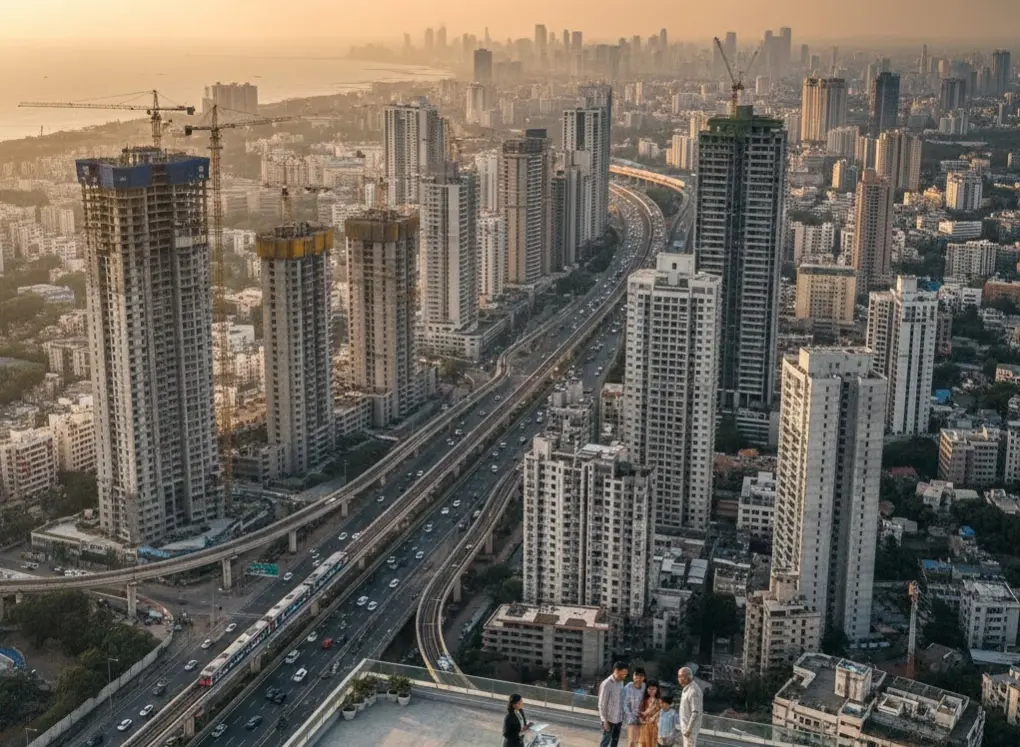
Mumbai in 2026 is no longer just India’s financial capital—it is a rapidly morphing megapolis where infrastructure megaprojects, shifting lifestyle preferences, decentralization of business districts, and aggressive real estate development are converging to create one of the most transformational decades in the city’s history.
From the coastal skyline of South Mumbai to the booming mixed-use hubs in the Mumbai Metropolitan Region (MMR), the city continues to reinvent itself. Real estate demand remains resilient, driven by both end-users seeking better lifestyle upgrades and investors chasing the strongest long-term appreciation potential in India.
What this guide covers
- Market overview in 2026
- Residential and commercial trends
- Top hotspots across MMR
- Impact of new infrastructure
- Luxury and ultra-luxury market evolution
- Investment outlook & future predictions up to 2030
Mumbai real estate market in 2026: The big picture
Post-pandemic structural shift is now permanent
By 2026, the behavioral shift that began in 2020 has crystallized into long-term demand patterns:
Buyer preferences:
- Families prefer bigger homes with functional layouts
- Homebuyers across income groups prioritize connectivity over proximity—high-speed expressways and metro lines have reduced the need to live next to job districts
- Amenities, security, and community living have overtaken the old “location only” mindset
Developer response:
- Adding more 2.5, 3, and 3.5 BHK options in the suburbs
- Creating integrated townships in KDMC, Navi Mumbai, Thane, Borivali-Virar belt, and Panvel
- Focusing on modern infrastructure: co-working spaces, EV charging, green zones, and future-ready materials
Inventory cycle tightens
Unsold inventory has reached its lowest level in a decade due to:
- Consistent end-user demand
- Stable pricing
- Limited new launches in land-constrained zones
- Premium and luxury segments remain particularly supply-starved
Interest rates stabilize
After years of fluctuations, financial stability in 2025–26 has restored buyer confidence. Mortgage rates remain accessible, encouraging mid-income and upper mid-income purchases.
Price appreciation in 2026
Across MMR, average appreciation has been:
- 8–12% annually in mid-income suburbs
- 12–18% in premium western suburbs
- 20%+ in micro-markets impacted by new infrastructure
Projected price increase by end of 2026: 12–15% citywide, with select corridors touching 18–22%.
Residential market trends defining 2026
1. Bigger homes dominate demand
Gone are the days when 1 BHKs made up the bulk of sales. Today:
- Young couples go straight for a 2 BHK
- Growing families prefer 3 BHK and above
- Compact luxury apartments with premium amenities are trending in Western Suburbs and Central Mumbai
2. Integrated townships & gated communities rise sharply
Township living is the strongest trend in 2026, offering:
- Schools
- Hospitals
- Clubhouses
- Retail
- Workspaces
- Parks and walking tracks
Buyers see townships as “future-proof investments” due to stable appreciation and sustainable living environments.
Top township zones emerging in 2026:
- Thane (Ghodbunder Road, Pokhran, Majiwada)
- Panvel & Ulwe
- Dombivli-Shil Road
- Mira-Bhayandar
- Kalyan-Titwala belt
3. Redevelopment wave at an all-time high
Mumbai’s aging building stock (particularly in South Mumbai, Western suburbs, Chembur, and Ghatkopar) has triggered:
- Massive redevelopment and society redevelopment
- Higher FSI utilization
- Entry of larger branded players into previously small-builder markets
Prime redevelopment clusters in 2026:
- Andheri West
- Bandra East
- Santacruz
- Ghatkopar East
- Chembur
- Bhandup & Mulund
4. Quality of construction becomes a deal-breaker
Buyers are more informed and unwilling to compromise on:
- Structural stability
- Materials used
- Lift and fire safety planning
- Ventilation & natural light
- Green building certifications
Branded developers with proven track records dominate the 2026 market.
Commercial real estate trends in 2026
Decentralized business hubs reshape the city
New commercial hubs are booming due to improved infrastructure and affordability:
- BKC–Kalanagar expansion
- Goregaon–Oshiwara corporate belt
- Airoli knowledge corridor
- Thane Wagle Estate 2.0
- Panvel – emerging MMR commercial capital
This decentralization reduces pressure on traditional business districts like Nariman Point, Andheri-Kurla Road, and Lower Parel.
Hybrid work fuels demand for flexible office spaces
Office real estate has evolved instead of collapsing:
- Co-working giants expand aggressively
- SME and start-up clusters form around metro-connected hubs
- Grade A spaces see record demand due to corporate consolidation
Retail real estate revival
Malls, high-street retail, and mixed-use commercial see a comeback in 2026, driven by:
- Experiential retail
- Food and beverage growth
- Entertainment hubs
- Walkable township planning
Top Retail Zones in Demand: Lower Parel, BKC, Andheri Lokhandwala, Thane, Vashi, and Powai.
Infrastructure impact: The real catalyst of 2026
Mumbai’s infrastructure transformation between 2024 and 2026 is the largest in the city’s history. For decades, the biggest constraints on real estate demand and affordability were:
- Limited east–west connectivity
- Poor last-mile transport
- Choked arterial roads
- Shortage of land for expansion
- Congested central business districts
- Dependence on local trains
But the 2024–2026 period has reversed this narrative. Today, Mumbai’s infrastructure is expanding faster than its real estate supply, creating a once-in-a-generation opportunity for growth.
1. Mumbai coastal road (South) — The western seafront transformer
The 10.58 km Coastal Road (Marine Drive → Worli → Bandra phase integration) marks the biggest mobility improvement for South & Western Mumbai in 50 years. Western suburbs luxury growth corridor
Purpose:
- Reduce travel time from South Mumbai to Western Suburbs
- Decongest major roads
- Create a high-speed sea-facing corridor
- Enhance the Western seafront’s real estate appeal
Travel time impact:
- Worli → Marine Drive: 40 mins → 8–10 mins
- Haji Ali → Nariman Point: 25 mins → 7–8 mins
- Bandra integration (Phase 2): Reduces the entire corridor congestion
Beneficiary micro-markets:
- Worli, Tardeo, Mahalaxmi, Byculla, Lower Parel
- Bandra–Khar–Juhu
- Andheri West & Oshiwara (indirect but strong impact)
Effects on homebuyers & investors:
- Sea-facing properties get premium status back
- Demand spikes for high-rise towers
- Ultra-luxury redevelopment accelerates
- Rentals rise due to faster commute
- Smaller older buildings get demolished for redevelopment
Price appreciation trend:
- 15–20% annual in Worli, Mahalaxmi
- 12–18% in Bandra–Juhu
- 8–12% in Andheri West
2. MTHL (Mumbai Trans Harbour Link) — India’s most transformative infrastructure project
MTHL is a 21.8 km sea bridge that connects Sewri (Mumbai) → Nhava Sheva (Navi Mumbai). This is the longest sea bridge in India and the most impactful infrastructure for future real estate.
Purpose:
- Seamless Mumbai–Navi Mumbai integration
- Boost port, logistics, warehousing & IT corridor
- Enable Navi Mumbai airport traffic
- Encourage decentralization of jobs
Travel time impact:
- Chembur → Panvel: 70 mins → 15–20 mins
- South Mumbai → Airport (Navi Mumbai): 2.5 hours → 40 mins
Direct beneficiary markets:
- Panvel, Ulwe, Dronagiri, Karanjade
- JNPT belt, Taloja Phase 2
- Kharghar & Kamothe
Effects on real estate:
- Panvel becomes MMR’s high-growth investment capital
- Corporate parks start shifting from Mumbai to Navi Mumbai
- Warehousing & logistics hubs emerge around Nhava Sheva
- Townships get major traction due to affordability
- Airport-linked hospitality demand rises
Price appreciation trend (2024–2030 projection):
- Panvel: 20–35%
- Ulwe: 18–30%
- Dronagiri: 25–40%
- Kharghar: 10–18%
This is the strongest long-term wealth-creation corridor in MMR.
3. Mumbai metro network (Lines 2A, 7, 3, 4, 5, 6 & 9)
By 2026, Mumbai’s metro coverage crosses 370+ km, making it one of the largest urban metro systems in Asia.
Purpose:
- Reduce reliance on local trains
- Improve last-mile connectivity
- Connect east-west suburbs effectively
- Reduce road congestion
- Enable affordable living far from job hubs
Key metro lines & their impact
Line 2A & 7 (Dahisar → Andheri → Gundavali)
- Major relief for Western Express Highway
- Dahisar & Mira Rd become high-demand markets
- Commercial hubs form in Borivali & Andheri Link Rd
- Price impact: 15–22% over 2 years
Line 3 (Aqua Line – Colaba → SEEPZ underground metro)
Mumbai’s most important metro line.
Benefits:
- Connects Cuffe Parade, Churchgate, Haji Ali, Worli, Dadar, Dharavi, BKC, Airport, SEEPZ
- South Mumbai becomes easily accessible
- Reduces traffic chaos
- Boosts premium real estate demand
Real estate impact:
- Mahalaxmi, Worli, Dadar: Ultra-premium demand
- BKC, Bandra East: New commercial towers
- SEEPZ, Marol, Powai: IT corridor expansion
- Appreciation: 12–20% depending on the micro-market
Line 4 (Wadala → Thane)
- Transformative for Eastern Mumbai
- Ghatkopar, Chembur, Mulund, Bhandup see high upgrade demand
- Price impact: 10–15%
Line 5 (Thane → Bhiwandi → Kalyan)
Massively important for:
- Industrial expansion
- Affordable housing belt
- Logistics hubs
- Bhiwandi’s transformation into a warehousing giant
Line 6 (Swami Samarth Nagar → Powai → Kanjurmarg)
- Connects Western Suburbs to Central Suburbs
- Powai and Kanjurmarg become premium IT residential corridors
- Jogeshwari East redevelopment accelerates
Overall metro impact on real estate:
Metro-proximate areas experience:
- 15–25% appreciation
- 8–12% higher rentals
- 40–60% faster absorption
- Strong investor interest
4. Navi Mumbai International Airport (NMIA)
Mumbai’s second airport, located near Panvel–Ulwe, is one of India’s most advanced aerotropolis developments. Phase 1 goes live (2025–26), full-scale by 2028–2030.
Purpose:
- Reduce pressure on Mumbai airport
- Enable global connectivity via Navi Mumbai
- Support logistics, tourism & hospitality
- Drive corporate migration to MMR-East
Impact zones:
- Ulwe, Panvel, Dronagiri, Karanjade
- Taloja, Kalamboli, Kharghar
Real estate impact:
- Hotels, offices & retail boom
- Ultra-premium residential belts emerge
- Warehousing demand surges
- Townships double in demand
Appreciation forecast (2024–2030): 20–40% depending on proximity & development stage
5. Goregaon–Mulund link road (GMLR) — The east–west revolution
A 4-lane twin tunnel connecting Goregaon East to Mulund.
Purpose:
- Remove east–west bottleneck
- Reduce Mumbai’s internal travel congestion
- Connect Western Suburbs directly to Thane
Travel time impact:
- Goregaon → Mulund: 75 mins → 12–15 mins
Beneficiary markets:
- Mulund East & West, Bhandup, Kanjurmarg
- Goregaon East, Jogeshwari East, Film City Road
Effects:
- Mulund transitions into a mid-luxury hub
- Bhandup redevelopment accelerates
- Goregaon East prices rise sharply
- Thane–Western Suburbs real estate exchange grows
Appreciation: 10–18%
6. Virar–Alibaug multi-modal corridor (MMC)
128 km economic corridor connecting: Virar → Bhiwandi → Kalyan → Taloja → Panvel → Pen → Alibaug
Purpose:
- Connect MMR’s extreme north to south
- Boost industrial & warehousing belts
- Reduce dependency on Mumbai city roads
- Unlock thousands of acres for new development
Real Estate Impact:
- Vasai–Virar belt gets premium township demand
- Taloja & Kalyan become logistic hubs
- Panvel gets seamless MMR integration
- Alibaug–Pen belt becomes second-home hotspot
Appreciation: 10–25% long-term
7. SCLR, Elevated roads, New flyovers & Suburban upgrades
Recent additions:
- Santacruz–Chembur Link Rd expansion
- BKC–Kalanagar flyover
- Andheri–Versova link
- Borivali–Thane tunnel (upcoming)
- Powai–Vikhroli connectors
Impact:
- Faster internal connectivity
- Reduced traffic pressure
- Balanced migration across suburbs
Infrastructure’s overall impact on MMR real estate
Key Outcomes:
- Decentralization of business hubs — New CBDs emerge in Airoli, Panvel, Ghansoli, Thane
- Residential value spreads across MMR — Premium living no longer restricted to Bandra–Juhu or South Mumbai
- Price appreciation driven by connectivity — Areas previously considered “far” (Panvel, Kalyan, Mira Road) now experience strong demand due to infrastructure upgrades
- Faster commute = Higher rentals — Metro-connected properties yield higher rent
Investors gain multiple new high-growth corridors — Especially: Panvel, Ulwe, Thane, Mira Road, Goregaon East, Mulund
The Hottest real estate micro-markets of 2026
Here are the standout hotspots ranked by end-user demand, infrastructure impact, and investment ROI potential.
1. Panvel – MMR’s rising star
Reasons for demand:
- MTHL connectivity
- Airport proximity
- Upcoming corporate parks
- Large land parcels & new township projects
Best investment sectors:
- New Panvel, Panvel East
- Karanjade, Palaspe
- Ulwe extension
2. Thane – Maharashtra’s fastest maturing city
Thane in 2026 is a self-contained city with:
- Top schools
- Best malls in MMR (Lakeshore, Korum, R-City proximity)
- Upcoming Metro 4 & 5
- Lakeside and greenery-rich neighborhoods
Top hotspots:
- Majiwada, Kolshet Road
- Pokhran 1 & 2, Ghodbunder Road
- Manpada
3. Chembur – Eastern Mumbai’s comeback
Why Chembur is booming:
- Access to BKC, Lower Parel, and Navi Mumbai
- Metro connectivity
- Redevelopment unlocking large parcels
- Premium high-rise gated complexes emerging
Areas to Watch: Chembur East, Raheja Acropolis zone, Eastern Express corridor
4. Mira Road – Value and connectivity
Metro, highway upgrades, and coastal road phase extension has turned Mira Road into a top middle-class destination.
Key features:
- High-rise clusters
- Modern amenities
- Reasonable ticket sizes
Emerging hotspots: Mira East, Penkarpada, Indralok extension
5. Powai – Evergreen premium suburb
Powai maintains strong demand because of:
- Corporate presence
- Lakeside views
- Urban lifestyle
- Quality schools and social infrastructure
2026 sees new luxury launches by top builders.
6. Dombivli–Kalyan – Affordable to mid-premium boom
Underpinned by:
- Metro expansion
- Panvel–Virar corridor
- New township ecosystems
- Strong investor activity due to lower entry prices
7. Western suburbs premium belt
Bandra → Santacruz → Khar → Juhu → Andheri West
Remains Mumbai’s trendiest real estate corridor.
Demand fueled by:
- Entertainment industry
- High disposable incomes
- Sea connectivity via Coastal Road
- Rapid redevelopment
Luxury pricing remains highest in Western India.
Mumbai luxury & Ultra-luxury market – 2026 edition
South Mumbai still reigns supreme
Malabar Hill, Walkeshwar, Cumballa Hill, and Worli maintain unmatched prestige.
Trends:
- Larger 4–5 BHK units
- Sky villas
- Sea-view penthouses
- Second-home luxury purchases by global Indians
Bandra–Juhu belt reaches new highs
The Coastal Road has intensified demand for sea-facing properties.
Celebrity-driven micro-markets include:
- Carter Road
- Bandstand
- Juhu Beach Road
Luxury shifts to east Mumbai
Areas like Chembur, Wadala, and Sewri (driven by trans-harbour link) see premium luxury launches.
Investment outlook for 2026–2030
Where should investors focus?
High-growth investment corridors:
- Panvel & Ulwe
- Thane (Pokhran, Majiwada, Bhiwandi)
- Mira Road East
- Kalyan–Dombivli–Taloja belt
- Goregaon East (GMLR effect)
- Mulund (East-West connectivity)
Realistic ROI projections (2026–2030)
- Affordable segment: 8–12% annual
- Mid-premium: 12–16% annual
- Premium metros: 15–20%+ annual
- Airport + MTHL zones: 18–30% annual
Rental market predictions
- Corporate migration to Navi Mumbai boosts rentals
- Powai, BKC, Thane continue strong tenant activity
- Student housing demand increases in Kanjurmarg–Ghatkopar corridor
Future forecast: Mumbai real estate beyond 2026
By 2027–2028
- Metro phase 2 expansions complete
- Airport fully operational
- MTHL feeder connectivity upgrades
- Corporate hubs emerge in Panvel and Airoli
By 2029–2030
- South Mumbai to Navi Mumbai commute becomes seamless
- Real estate prices surge in extended suburbs
- Mumbai becomes one of Asia’s top 5 luxury real estate markets
Long-term prediction up to 2035
MMR becomes a 3-CBD city:
- BKC
- Airoli–Ghansoli
- Panvel Aerotropolis
This decentralization will dramatically reshape residential demand.
Conclusion: Mumbai 2026 – The start of a new real estate era
Mumbai’s real estate market in 2026 is defined by infrastructure-led growth, massive redevelopment, lifestyle upgradation, decentralization of business districts, and a new generation of homebuyers who want quality over compromise.
The city is expanding not just geographically, but economically and culturally.
For end-users, 2026 is one of the best periods to upgrade to larger, better-located homes.
For investors, several corridors are entering their strongest appreciation cycle in a decade.
The next 10 years will witness an unprecedented transformation—and 2026 is just the beginning.
FAQs
Mumbai’s new infrastructure is profoundly reshaping the real estate market by enhancing connectivity between traditional and emerging areas. Projects like the Coastal Road, Metro lines, Mumbai Trans Harbour Link (MTHL), Goregaon–Mulund Link Road (GMLR), and upcoming corridors in Navi Mumbai have reduced commute times, unlocked previously inaccessible micro-markets, and encouraged demand in suburbs. This transformation has shifted buyer preferences from location-only choices to connectivity-led decisions, resulting in a more balanced and decentralized market. Areas once considered peripheral are now attracting both end-users and investors, creating strong capital appreciation potential and expanding options for residential, commercial, and mixed-use developments.
The major infrastructure projects influencing property prices in Mumbai include the Mumbai Coastal Road, Mumbai Trans Harbour Link (MTHL), Metro network (Lines 2A, 7, 3, 4, 5 & 6), Goregaon–Mulund Link Road (GMLR), Virar–Alibaug Multi-Modal Corridor, and the Navi Mumbai International Airport (NMIA). These projects create faster travel times, unlock large land parcels, and stimulate the growth of commercial hubs. Areas along these corridors—such as Panvel, Ulwe, Wadala, Thane, and Mira Road—are witnessing higher demand, faster absorption, rental growth, and significant capital appreciation. Infrastructure-led development is now the primary driver of property value in Mumbai, surpassing traditional location-based factors alone.
The top emerging hotspots in 2026 include Panvel, Ulwe, Thane (Pokhran, Ghodbunder Road, Majiwada), Wadala, Chembur, Mulund, Kanjurmarg, Mira Road East, and parts of Navi Mumbai near the airport corridor. These areas benefit from high-quality connectivity through metro, highways, expressways, and coastal road links. Additionally, the influx of corporate hubs, upcoming townships, and redevelopment projects is driving both residential and commercial demand. Each of these markets is witnessing rapid appreciation due to infrastructure, lifestyle amenities, schools, hospitals, and retail facilities, making them ideal for investors and end-users alike.
The year 2026 is considered a highly favorable investment period in Mumbai because the market is entering a strong growth cycle underpinned by infrastructure completion, rising end-user demand, and low unsold inventory levels. Mortgage rates are stabilized, improving buyer confidence. Redevelopment projects are modernizing older neighborhoods, adding premium housing supply, while township and integrated development projects are providing lifestyle-driven options in emerging areas. With multiple high-growth corridors maturing simultaneously, both short-term rental income and long-term capital appreciation are expected to be robust, making this period optimal for investors and homebuyers alike.
Investors can expect varied returns based on location and segment. Affordable and mid-income suburbs are projected to deliver 8–12% annual capital appreciation, mid-premium zones around 12–18%, and infrastructure-driven corridors—such as Panvel, Ulwe, and metro-connected suburbs—could see 15–30% annual appreciation between 2026–2030. Rental yields remain strong in areas close to commercial hubs and metro lines, averaging 3–5%, while premium locations in South Mumbai, Bandra, Juhu, and Powai continue to attract high-net-worth investors seeking long-term value and luxury lifestyles. Infrastructure-driven growth is the key factor for both ROI and rental potential.
Homebuyers should prioritize proximity to infrastructure such as metro stations, expressways, arterial roads, and upcoming transit hubs, which directly affect future property appreciation. Developer credibility and past track record are crucial to ensure construction quality, timely delivery, and RERA compliance. Buyers should also evaluate neighborhood social infrastructure, including schools, hospitals, retail, and recreational amenities, as well as lifestyle factors like security, green spaces, and integrated township benefits. Long-term value appreciation, ease of commute to work hubs, and accessibility to commercial zones are now the most decisive factors in choosing property in Mumbai’s 2026 market.

Write Your Comment