
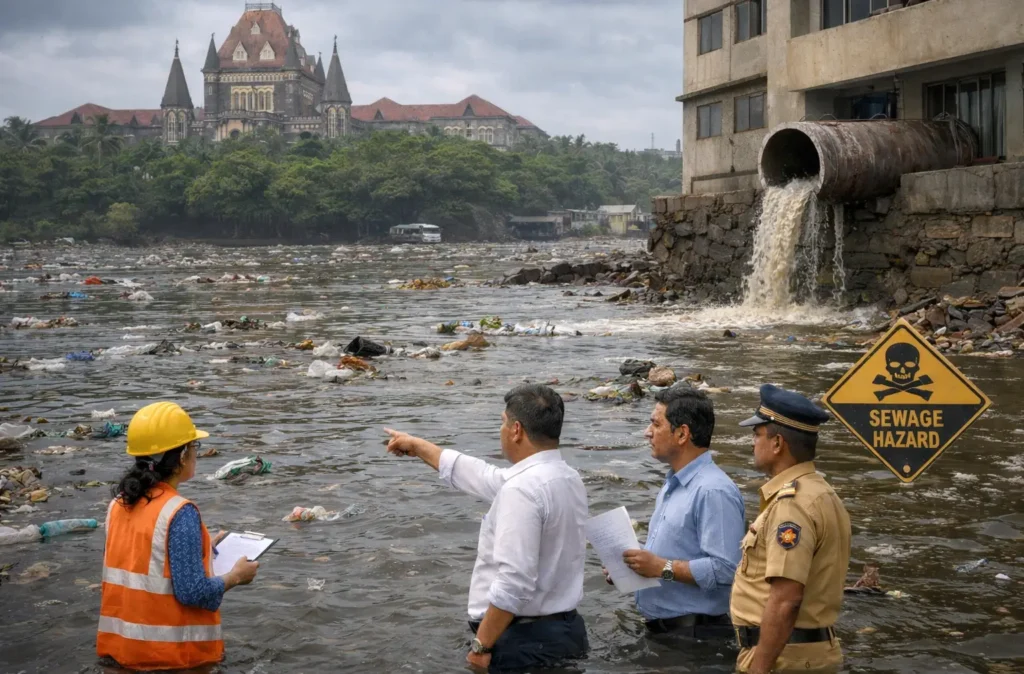
MUMBAI – In a move that signals a major shift in urban development and environmental protection, the Bombay High Court has issued a state-wide directive prohibiting the issuance of Occupancy Certificates (OC) to buildings that lack functional sewage treatment facilities.
The division bench, comprising Justices Ravindra Ghuge and Abhay Mantri, passed this order while expressing grave concern over the “enormous magnitude” of untreated waste being discharged into natural water bodies. The court made it clear that urban growth cannot come at the cost of the state’s environmental health.
The ulhas river crisis
The ruling was triggered by a petition highlighting the dire state of the Ulhas River. Investigations revealed that approximately 438 unauthorized structures in the Thane district were dumping raw sewage directly into the river due to a lack of proper sewage treatment plants (STPs).
“The municipal council must initiate steps to ensure that pumping of sewage into the river is reduced and eventually stopped,” the bench noted. The court emphasized that high-rise buildings, in particular, must have independent STPs unless they are verified to be connected to an official municipal underground drainage network.
Accountability for builders and officials
The High Court’s directive introduces a new layer of personal and corporate accountability. Key highlights of the enforcement plan include:
- Blacklisting: Authorities have been instructed to begin the process of blacklisting developers and construction companies that fail to provide promised sewage treatment systems.
- Action against officials: In a stern warning, the court stated that any civic official found granting an OC to a non-compliant building would face legal action.
- State-wide audit: Civic bodies across Maharashtra are now mandated to audit existing buildings to identify those operating without required STPs.
Impact on the real estate sector
For the real estate industry, this ruling turns a “good-to-have” amenity into a non-negotiable legal requirement. Developers must now ensure that sewage treatment infrastructure is fully operational before buyers are allowed to move in.
Environmental activists have welcomed the move, noting that for too long, sewage management was treated as a secondary concern. The court has scheduled a follow-up hearing for January 28, 2026, to review the progress made by municipal authorities in implementing these new standards.
Also read – A new landmark in Mumbai: Exploring the Raymond Realty Wadala project
Disclaimer – This article provides general news information regarding recent court rulings in Maharashtra. It does not constitute legal advice. Readers should verify specific building regulations with local municipal authorities or legal experts.
Source – ET Realty

Write Your Comment