
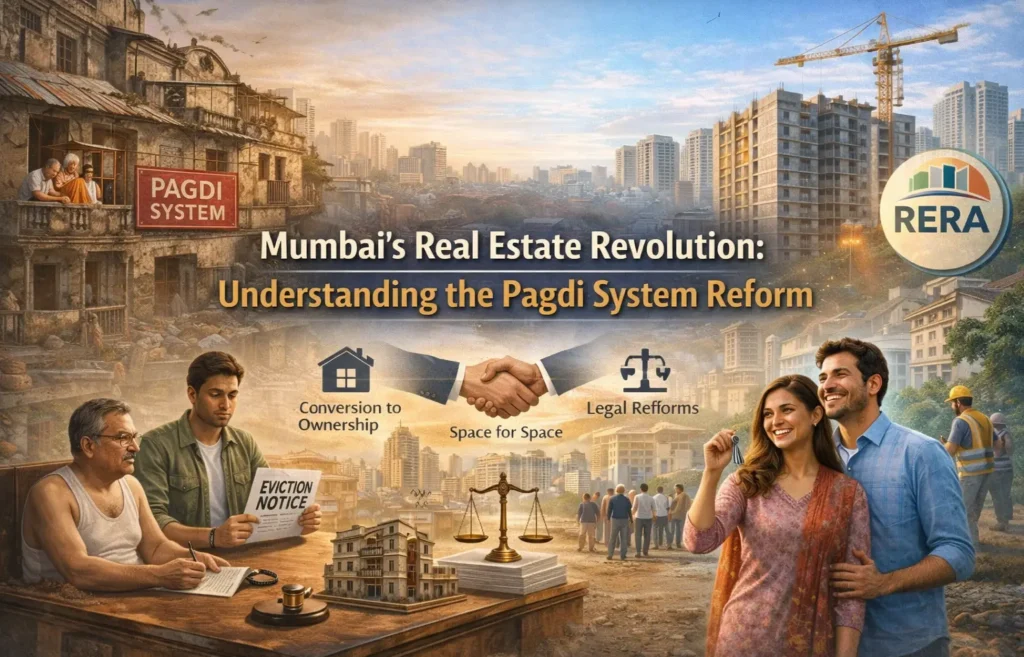
For over a century, a unique housing model known as the Pagdi system has defined the architecture and community of South and Central Mumbai. While it allowed generations of families to live in prime locations at very low costs, it also left thousands of buildings in a state of decay. Now, a major policy shift is set to change everything. The Maharashtra government has announced a new regulatory framework to move away from this old model, aiming for a “Pagdi-free” Mumbai that favors both safety and ownership.
What is the Pagdi System? To understand the reform, we first need to look at the tradition. In this system, a tenant pays a large upfront lump sum (the “Pagdi”) to a landlord. In return, they get to stay in the property almost indefinitely while paying a very small “token” monthly rent. Because these rents were frozen decades ago, many families today pay as little as ₹500 for apartments that would otherwise cost thousands.
While this provided security for tenants, it left landlords with no money to maintain the buildings. As a result, many of these historic structures became unsafe and dilapidated.
The new plan: From tenant to owner, the core of the new Pagdi system reform is to unlock the deadlock that has stalled redevelopment for years. The government’s plan focuses on three main pillars:
- Ownership rights: The goal is to eventually convert these tenancies into formal ownership. Instead of being perpetual renters, residents will receive modern, self-contained apartments in newly constructed buildings.
- Space for space: Under the new rules, tenants will be entitled to a new flat equivalent to the area they currently occupy. For those from low-income groups, the government plans to ensure these new homes are built at no cost to the residents.
- Support for landlords: Landlords, who previously felt trapped by low rents, will receive incentives like additional construction rights (Floor Space Index or FSI). This makes it financially attractive for them to work with developers to rebuild.
Solving legal hurdles, one of the biggest reasons redevelopment projects fail in Mumbai is legal disputes. There are currently over 28,000 cases between tenants and landlords stuck in courts. To fix this, the state plans to set up fast-track courts. The objective is to clear this massive backlog within three years, ensuring that projects can move forward without being tied up in red tape.
A safer, modern Mumbai, this reform is about more than just paperwork; it is about saving lives. With over 13,000 buildings in urgent need of repair, moving toward a modern ownership model ensures that residents are moved out of crumbling structures and into safe, RERA-protected homes.
As the city says goodbye to a century-old tradition, the focus remains on a future where every Mumbaikar has a safe, legal, and permanent roof over their head.
Also Read – Navi Mumbai civic body halts projects to protect city air quality
Disclaimer – This article provides a general overview of the Pagdi system changes. Housing laws are complex; readers should consult official government notifications or legal experts for specific advice on property rights.
Source – ZeeBiz

Write Your Comment